

Birds of New Guinea Field Guide (2nd Edition)
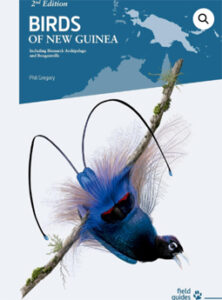 Birds of New Guinea Field Guide
For many birders, visiting the island of New Guinea would have been an unachievable dream for much of their life but over the last few decades it has become a birding hotspot which requires its own specialized field guide. Lynx Edicions has added the Birds of New Guinea field guide to their catalogue and while it is not the only guide on the market, due to its size it is the only true field guide that is convenient to take on one’s travels. The soft cover version of this book is light in weight and is the natural recommendation as the field guide for the tours we offer to this region full of incredible birds.
Birds of New Guinea is the field guide that we will use on our birding tour itineraries in West Papua:
- West Papua Birding Tour
This birding tour, full of some exceptional birds, is best enjoyed if using this birds of New Guinea field guide. Using older regional field guides is likely to be confusing due to the older taxonomy used in these publications. Birds of New Guinea, by Lynx Edicions, is the most up-to-date guide currently available.
Range Maps
Range maps for every species are printed alongside the illustrations which makes for nice, quick reference. However, while range maps are an essential, in our opinion, because of the very large area of land covered and the small space for the maps, they are of limited assistance here because they cannot focus in for high levels of accuracy. The maps are, though, helpful for eliminating species that don’t obviously occur near any given birding location. The range maps use blue and green colouration to depict migratory of resident species which is easy to recognize quickly. In summary, the range maps in this field guide are an assistance but far from offering pinpoint accuracy.
Illustrations
The quality of the printing and style of the illustrations in this field guide are of a consistent quality, which is extremely important in our opinion. The reproduction is bright and there is good contrast with the background to make the birds “pop out” from the page which draws the eye in and, as with many of the other Lynx publications, many of the illustrations are drawn from Handbook of the Birds of the World. Generally the illustrations are also well-spaced and each bird is reproduced at a good size so that a reasonable level of detail can be seen. However, presumably due to limitations of space, there are no juvenile plumages displayed and flight illustrations are limited too, although generally provided for the species most frequently seen in flight, but the omission of flight illustrations for many of the parrots is a shame.
While the quality of the plates is more than sufficient, as usual, some groups of birds are not dealt with as well as they might be. Some of the honeyeaters are rather poorly illustrated and are confusingly similar or are just not well represented. Similarly, many of the raptors appear in a limited selection of plumages making identification very dificult without supplementary material. Once again, presumably this is done to save space.
Species Accounts
The accounts for each species provide a lot of relevant information for birders, packed into a small space. Indeed, to achieve this the size of the text is perhaps smaller than is convenient for many older birders. The text includes whether a bird is common, scarce, a migrant or resident close to the name of the bird, which can be helpful in the field. The text lists known subspecies occuring in the region, although there may well be much to add to this knowledge. Call descriptions are short and concise, which is wonderful considering the long meandering and meaningless descriptions that occupy too much space in some field guides.
Brief descriptions of juvenile birds in the text go at least some way to these plumages not being illustrated. However, perhaps the most useful information, given the vast number of taxonomic changes, is the section that list former names and alternative names for each bird. Overall the species accounts are well-constructed and much more useful than in many other publications.
Other Features
The Birds of New Guinea field guide comes in a soft cover version which has a sort of waxy, plastic feel to it. In the humid conditions of New Guinea this is perfect for protecting the book and a very good innovation which has become common to Lynx Edicions field guides. This also weighs significantly less than hardback books; great for carrying on long journeys.
The introductory section of this field guide is shorter than in most books but packs in a surprising amount of information, including notes on the key species for birding hotspots in the region. However, although birders want well-illustrated plates, species accounts and range maps from a field guide, further information on the region would have been nice.
There is a QR code for each species. Scanning this leads users to the eBird page for that species with all the information, maps, photos that the website provides. This depends on having an internet connection of course.
There is also a section, at the back of the book, listing and illustrating, with brief species accounts, vagrant species. It is useful that these seldom-occuring birds do not clog up the main body of the book but it is nice to know what to look out for in terms of rarities. A nice but, perhaps, non-essential part of the book.
One feature that is lacking, which is a shame, are species names in Indonesian. Presumably this is not just an oversight and rather in recognition to the large number of local languages in the region and political tensions. Similarly, the index does not include local names.
Recommended
We strongly recommend that all people joining our trip to West Papua obtain a copy of this field guide. It is always really helpful to look through the book a number of times, pre-trip, to become familiar with the families of birds we will see and to know what the main target species look like. Our guides will be using this field guide when leading our West Papua birding tour.