

Thailand Birding Trip Report Jan/Feb 2026
Tour Leader: Joma Blair
Dates: 22nd January – 11th February
Thailand Birding Trip Highlights:The following list contains species that in some way stood out due to their visual impact, rarity, interesting behaviour, particularities of the encounter, or a mix of any of the above. Often, the things that make a bird encounter memorable are somewhat intangible.
- Rufous-throated Partridge
- Green Peafowl
- Grey Peacock Pheasant
- Mrs Hume’s Pheasant
- Silver Pheasant
- Siamese Fireback
- Chinese Egret
- Indian Thick-knee
- White-faced Plover
- Spoon-billed Sandpiper
- Asian Dowitcher
- Nordmann’s Greenshank
- White-fronted Scops Owl
- Spot-bellied Eagle Owl
- Himalayan Griffon
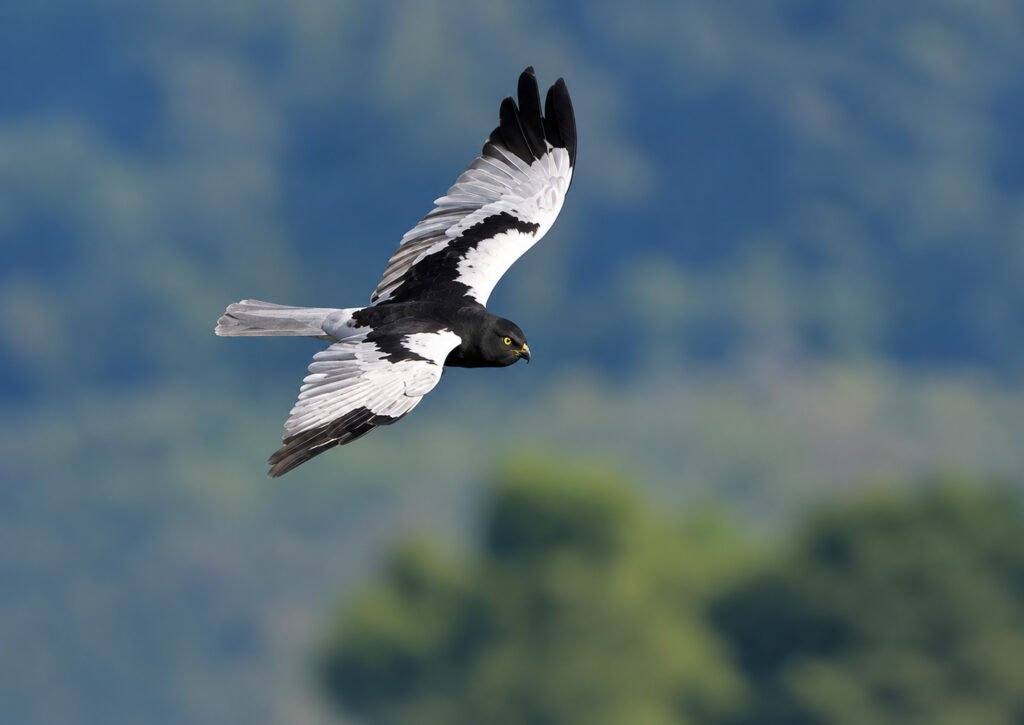
- Pied Harrier
- Orange-breasted Trogon
- Red-headed Trogon
- Great Hornbill
- Rusty-cheeked Hornbill
- Banded Kingfisher
- Black-headed Woodpecker
- Collared Falconet
- Black-thighed Falconet
- Blue-naped Pitta
- Eared Pitta
- Blue Pitta
- Long-tailed Broadbill
- Black-and-red Broadbill
- Ratchet-tailed Treepie
- Sultan Tit
- Pygmy Cupwing
- Slaty-bellied Tesia
- Chestnut-headed Tesia
- Black-throated Tit
- Grey-headed Parrotbill
- Spot-breasted Parrotbill
- Rufous Limestone-babbler
- Himalayan Cutia
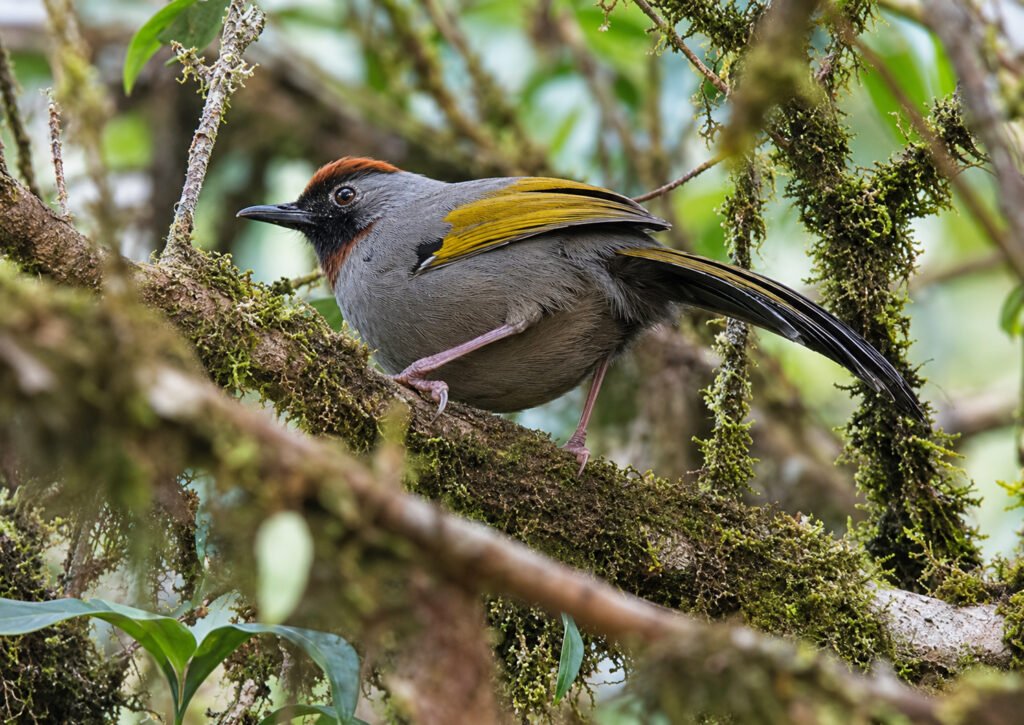
- Silver-eared Mesia
- Scarlet-faced Liocichla
- Giant Nuthatch
- Dark-sided Thrush
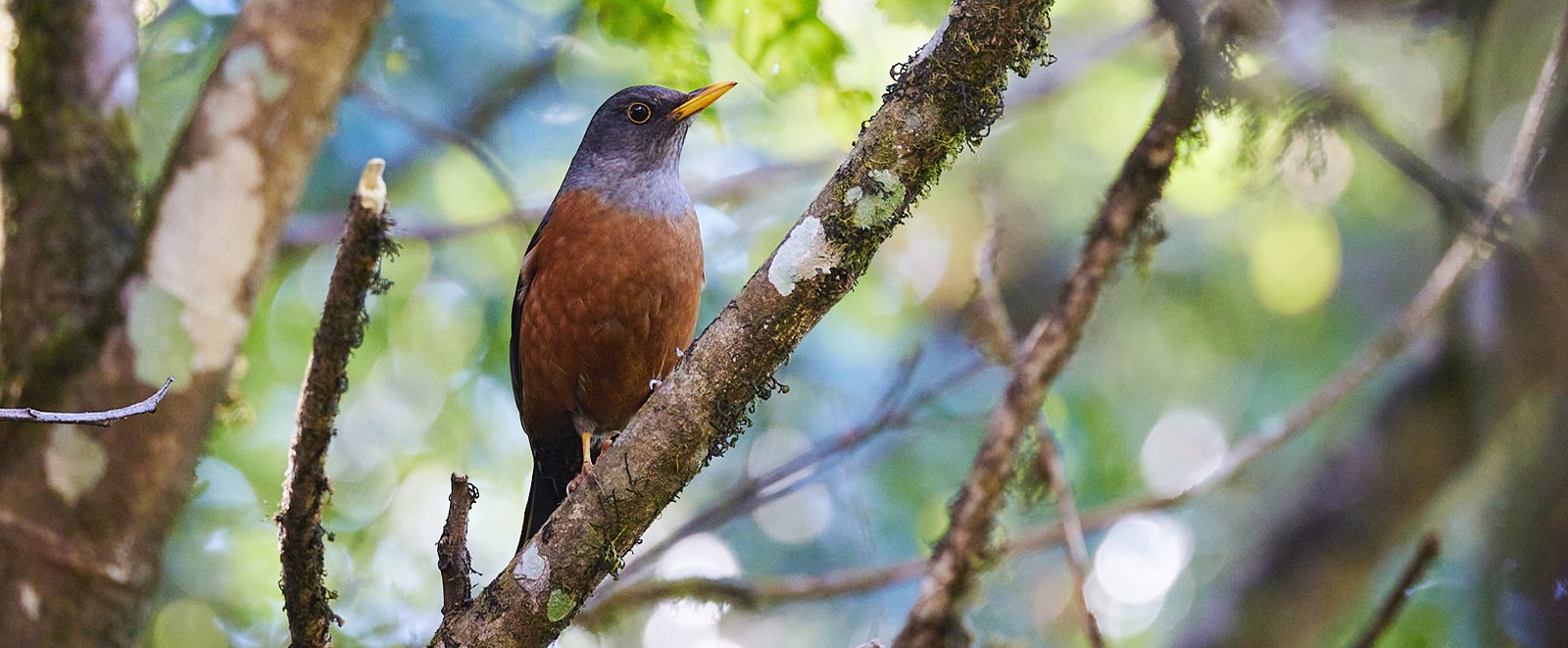
- Chestnut Thrush
- Siberian Rubythroat
- Slaty-backed Forktail
- White-throated Rockthrush
- Pin-tailed Parrotfinch
- Scarlet Finch
- Yellow-breasted Bunting
Summary:
Birds to right of them, birds to left of them, birds in front of them, ticked and photographed! This adaptation of Alfred Lord Tennyson’s words attempts to convey both the abundance and variety of birds that were seen on this birding tour to North and Central Thailand. Additionally, the above list of highlight species serves to illustrate the extremely high quality of the birds that we were able to enjoy. The success rate with our target species was very high and there were a number of exceptional surprises along the way too, which made for an even more exciting trip than had been expected. Starting in Chiang Mai our first morning a short drive out of town provided us with a wide variety of species before moving on to the mountains of Doi Lang and Doi Ang Kang for few days where birding along the Thai-Myanmar border for a plethora of quality high-altitude birds that included Mrs Hume’s Pheasant, Scarlet-faced Liocichla, Spectacled Barwing, Himalayan Cutia and Giant Nuthatch to mention a few. In the rice fields at the foot of the mountains a wide variety of wetland and open-country species were seen and we made a special journey for one of the big trip highlights: Blue-naped Pitta. Moving on to Doi Inthanon an extended time here gave us plenty of opportunity to enjoy this wonderful site where the summit, typically, provided us with some close encounters with species such as Chestnut-tailed Minla and Green-tailed Sunbird. Flying south to Bangkok we then headed for the Gulf of Thailand to connect with the critically endangered Spoon-billed Sandpiper before spending several days at the superb Kaeng Krachan National Park where birds such as Blue Pitta, Grey Peacock Pheasant and Great Hornbill were to be seen. Heading back to the Gulf of Thailand for several days allowed us to explre the myriad of wetland birds of the salt farms and rice fields before driving some distance to Khao Yai National Park. Here we enjoyed more excitng birds of the forest which included numerous Red-headed Trogons, stunning Banded Kingfisher and wonderful Silver Pheasant among other prizes. From here we stopped at a temple surrounded by limestone outcrops for the endemic Rufous Limestone Babbler before heading back to Bangkok where this Thailand birding tour concluded.
Join us on our next birding tour to Thailand. See the full itinerary and book here – Thailand Birding Tour.
Field Guide
Birds of Thailand by Uthai Treesucorn & Wich’yanan Limparungpatthanakij, published by Lynx Edicions. This field guide is currently the most up-to-date publication covering the birds of Thailand and comes in a water-resistant, soft back version which makes it suitable for carrying on trips. The checklist used was based on AviList and eBird taxonomy with reference to some of the names used in this field guide.
Day 1; 22nd January – Arrival Chiang Mai
After long journeys to arrive in Thailand, our group met in Chiang Mai to kick off this tour with an exemplary first meal. Dining at a Michelin-starred restaurant a short journey from the old city, this was a great introduction to the delicious Thai cuisine that we would enjoy throughout our trip.
Day 2; 23rd January – Mae Taeng – Huay Bong Reservoir – Fang Rice Fields
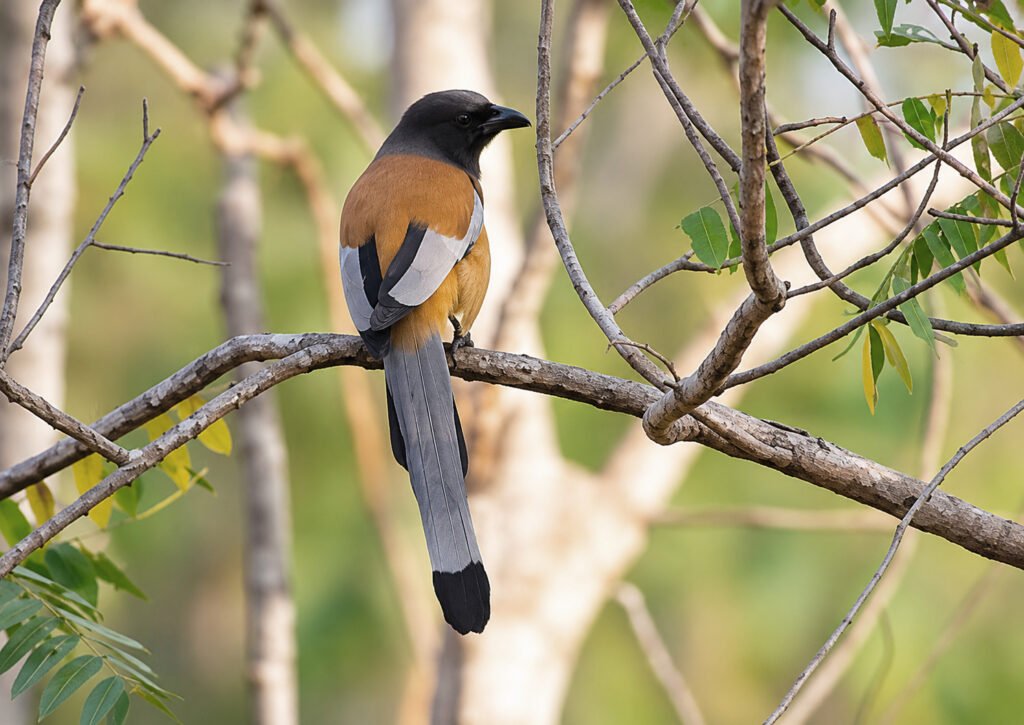
The next day, we began our Thailand birding trip with a journey north, early so that we would arrive at our first stop, Mae Taeng, at dawn. This irrigation project is home to a wide array of water-adjacent and forest-edge birds, and from the moment we exited our vehicles we were surrounded by activity. We began by familiarising ourselves with many species that would become consistent companions throughout the trip such as Coppersmith Barbet, Siamese Pied Starling, and Dusky Warbler. Greater interest soon appeared with a large flock of Small Minivets, four Red-billed Blue Magpies, and a pair of Rufous Treepies which gave excellent views. We paused to have our breakfast and morning coffee, prepared for us by our excellent drivers, but birding never truly stops and we watched a Yellow-browed Warbler flycatch from a tree above us while we ate. This was a good opportunity for us to get to grips with the features and call of this species, essential for comparing against the many less common Phylloscopus warblers that inhabit Thailand in the winter. Walking along a stream trail, we watched our first Asian Green Bee-Eaters fly acrobatically over the reeds, before the bright flashing bellies of a pair of Wire-Tailed Swallows prompted much excitement. A prowling Shikra added some predatory menace. A great introduction to Thailand’s birds!
We continued north, noting roadside birds like Ashy Woodswallow as we went, then stopped to explore Huai Bong Reservoir. A small group of Lesser Whistling-Ducks congregated on the reservoir, and another pair of Red-Billed Blue Magpies were spotted distantly. Then, as we were scanning the trees near the reservoir, and a flock of vibrant Scarlet Minivets came brilliantly into view. They gave us plenty of time to watch them as they foraged from tree to tree. A fruiting tree further down the path was a flurry of activity, and gave us the opportunity to watch Black-headed-, Black-crested-,and Sooty-headed Bulbuls feeding. Near the end of the path, we followed the sound of a raptor calling and found a Crested Goshawk perching just a few meters above our heads; the undoubted highlight. A number of our group had at least a passing interest in butterflies, and several attractive species turned our heads when the birding lulled – not least the Fluffy Tit and Common Rose Swallowtail.
Our lunch stop was at a picturesque restaurant surrounded by beautiful gardens under the shadow of Doi Chiang Dao (Thailand’s third highest mountain.) Before eating we had some time to explore the grounds, and spotted a Rufous-winged Buzzard perched nearby. It soon took flight and begun circling over some nearby paddy fields where it was joined by its mate. Our final pitstop was at a forested pool at the base of Doi Chiang Dao. Though it was nice to pay a brief visit to this mountain, there wasn’t much of interest except a group of White-rumped Munia and we quickly moved on.
In the late afternoon we arrived at the Tangerine Ville Hotel in Fang, which was to be our base for the next five nights. We had a bit of time to refresh ourselves and get settled in before heading out to make the most of the evening light. Arriving at the rice fields just north of the town we were greeted by an array of species typical for this habitat. Several handsome male Amur Stonechats were present accompanied by the drabber females; as were our first Citrine Wagtails, looking particularly smart with their lemon-yellow heads. A good 50 Black-winged Stilts waded in a distant flooded field, while a flock group of Green Sandpipers periodically took flight. Black Drongos abounded, as did Spotted Doves and Eastern Cattle Egrets. A single Red Collared Dove attracted more attention as it flew past. We tried to stake-out a Chestnut-eared Bunting I had spotted from the car, but it frustratingly stayed hidden, and a flock of Scaly-breasted Munia were all we got for our efforts.
We soon picked up our scopes and ventured along some narrow tracks in search of more species. The singing of an Oriental Skylark had us scanning the skies and we soon spotted it as it performed its trademark display flight high above our heads. Then, at least five Pin-tailed Snipe flushed from the flooded fields, and gave a good demonstration of their distinctive features for those of us more familiar with their ‘common’ counterparts. Adding to the roster were both Brown and Long-tailed Shrikes, and the cute Taiga Flycatcher which is one of the commonest birds in Thailand at this time of year. The best had been saved for last though; as the sun dipped lower on the horizon, the unmistakable shape of a harrier swept low over the fields. It wasn’t long until this female was joined by the stunning male Pied Harrier, one of Asia’s most strikingly patterned raptors. We watched as it hawked further and further away in the dying light, before setting off back to the hotel, content at having capped off the day with such a quality bird.
Day 3, 24th January – Doi Lang West (Doi San Ju)
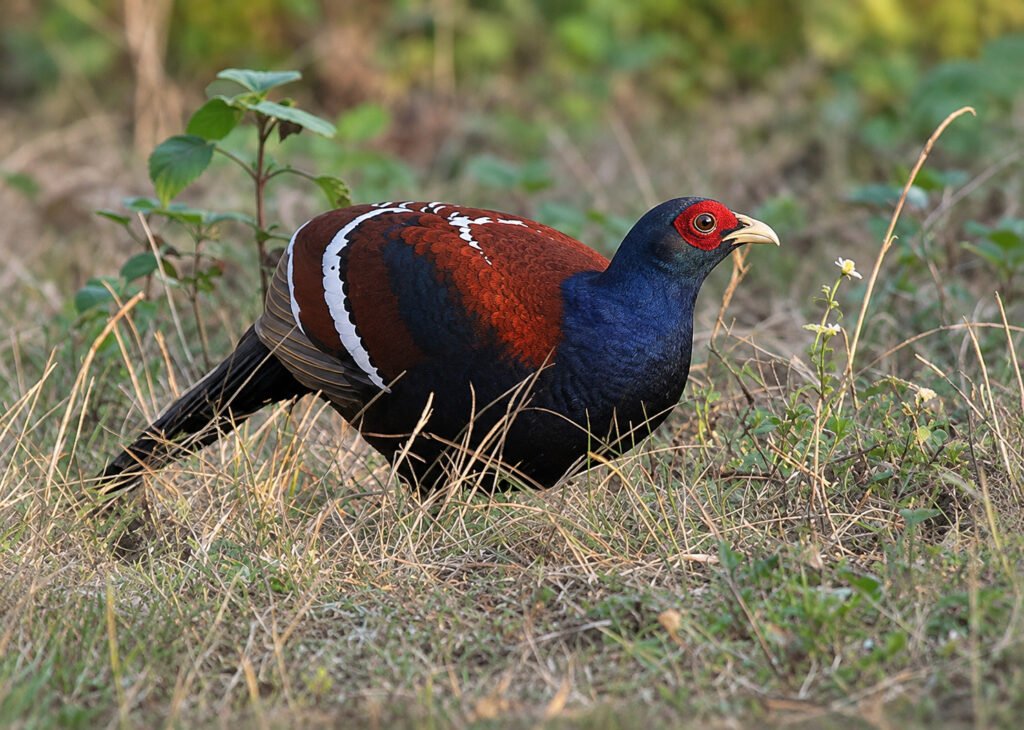
Doi Lang West is one of the best birding hotspots in Thailand. The amount of rare and range restricted species found here make it a must visit location for any birder visiting the country. We made an early start on the hour or so drive from our hotel to our first stakeout, and it was a crucial one, as this is one of the only places in the world where Mrs Hume’s Pheasant can be reliably seen. We reached the location to find a number of photographers already set up in portable hides. We parked up and assumed the best positions to look down the road from the van, wary of scaring off this very shy species, then settled in to wait. Sure enough, as the first rays of morning light trickled in, a splendid male and two females approached along the road. The low light levels and our position behind the early-bird photographers limited our photographic opportunities a bit, but we got satisfactory views as they continued to forage along the roadside for about ten minutes. They were joined periodically by a small group of Red-eyed Scimitar-Babbler, another specialty of Thailand’s northern highlands following their split from Rusty-cheeked Scimitar-Babbler in 2024. Eventually the pheasants melted away into the undergrowth, so we got out of the van to celebrate seeing this big target so early, and to start birding the surrounding area. Locating the chattering calls of more Red-eyed Scimitar-Babbler allowed us to get much closer views of this odd, fierce looking bird. The forest around this spot is mostly old-growth pines, and we spotted a several Chestnut-vented Nuthatches flicking between the canopies. Our attentions turned between Grey Bushchats, a female Daurian Redstart, and a lovely male Rufous-gorgetted Flycatcher which took a bit of time for everyone to see well as it skittishly flicked around us. While watching a handsomely marked Olive-backed Pipit, a young Grey-backed Shrike settled on a branch further down the road, and soon after a Rufous Turtle Dove flew in lit by gold morning light. It took some time to locate the haunting whistle of a Black-backed Sibia in the treetops.
We then drove up to a series of feeding stations along the road. A Black-breasted Thrush was dominating the first one, a winter visitor to Thailand that we had hoped to find. A pair of Orange-breasted Leafbird vocalising in the canopy above made us strain our necks to get decent views. The next few feeding stations were being visited by a female Rufous-bellied Niltava, a pair of Slaty-blue Flycatchers, another female Daurian Redstart, and last and best of all, a Siberian Rubythroat.
Further up the road, the trees thinned out to reveal dozens upon dozens of Cook’s Swifts flying low overhead, a large and impressive swift of mountainous areas. We met another group of who were photographing a flock of Mrs Gould’s Sunbirds, and stopped to spend some time watching this beautiful high-altitude species. Further still, a Spectacled Barwing was a delight to see; with its cute expression and inquisitive manner it became a cult favourite amongst our group. At this point I spotted a massive raptor gliding lazily overhead which turned out to be a Himalayan Griffon Vulture – a vagrant to Thailand and excellent bird for the trip. Special credit goes to Roger for immediately ascertaining the correct ID in the field without the need for photographs.
We set up for lunch by one of the more active feeding stations at a well forested area called ‘the Oasis’ and treated ourselves to some excellent armchair birding. Groups of Yunnan Fulvettas and White-browed Scimitar-Babblers, and a pair of Grey-throated babblers all took their turns. We had allocated a good amount of time to birding at the Oasis after lunch which brought us Large Niltava, Pale Blue Flycatcher, Hill Blue Flycatcher, Velvet-fronted Nuthatch, and Hume’s, Chestnut-crowned, Claudia’s, and Davison’s Leaf Warblers. One of our big targets, the Giant Nuthatch had remained elusive, so we ventured into a small track behind the Oasis in search of them. This brought us close views of Hume’s Treecreeper and more Chestnut-vented Nuthatches but not the giants we were after. We weren’t too concerned as we had budgeted enough time to try for this species multiple times while in the North, so we carried on.
The last of the stakeouts is as high as you can go on Doi Lang West, because it sits directly in front of the military checkpoint. A Stripe-breasted Woodpecker perched on dead tree greeted us on arrival. We settled in to wait for another big target known to frequent the papaya on offer at the feeding station, and it wasn’t long before they appeared – a pair of Scarlet-faced Liocichla. This laughingthrush is a high-altitude beauty with vivid crimson on its face and wings. The pair returned several times over the remainder of our afternoon here, alongside Flavescent Bulbuls and a bold Oriental Magpie Robin. While some people waited to photograph them, the rest of us explored the surrounding vegetation. We quickly found a small flock of Ashy Bulbuls, one of the best-looking examples of its family, and some of us had brief views of Striated Bulbul. We got really excited when a pair of chunky, scaly looking finches flicked briefly into view. These were female Scarlet Finches, a Himalayan species rare in Thailand but which may be breed at Doi Lang – if so, this represents the southernmost extent of their range. Unfortunately, they were never joined by the handsome crimson male, but you can’t complain at finding a bird this rare. This area didn’t let up in quality, as a big mixed flock soon rolled in containing Grey-headed Parrotbills, Blue-winged Minla, Asian Tit, the well-marked Rufous-backed Sibia and the impossibly cute Black-throated Tit, making it hard to know where to look. After they passed, we took a bit of time getting everyone onto both the Golden-throated and Blue-throated Barbets which had been filling the area with their calls. With that, we set off for the hotel, stopping only to enjoy some some well-earned cans of Leo as we watched the last light fade away.
Day 4, 25th January – Doi Lang East
This section of the Doi Pha Hom Pok National Park is only accessible via a poorly maintained dirt track, which meant swapping our comfortable, airconditioned vans for local 4x4s trucks. The road was both bone-shakingly bumpy and very dusty, so it was a relief when we stopped to locate a Bay Woodpecker our local guide had heard from the truck. Unfortunately, it stayed distant and only a few people caught brief flashes of it in flight. A Davison’s LeafWarbler was singing nearby, a lovely up-down-up-down whistling we became very familiar with across our time in the north. We next stopped to scan some agricultural fields on the route, but only saw common species like White-throated Kingfisher, Chinese Pond Heron and Black-collared Starling so we quickly decided to push on toward better habitat. We finally arrived at a large feeding station surrounded on all sides by pristine forest, which was playing host to a mixed group of Brown-crowned Scimitar Babblers and Silver-eared Laughingthrushes. These were then joined by a pair of Chestnut Thrushes, quite a rare and handsome winter visitor. A couple of the migratory ‘black-billed’ subspecies of Blue Whistling-Thrush skulked in the surrounding vegetation. We also enjoyed the opportunity to spend more time with species we’d seen yesterday, with Scarlet-faced Liocichlas, Barwings, Mrs Gould’s Sunbirds, and both Sibias also in attendance. In the trees, an active Buff-barred Warbler drew our attention as it foraged for insects, as did a Slaty-backed Flycatcher which occasionally settled on the feeding station. Scanning a fruiting tree across the track we found one of our big targets, Whiskered Yuhina feeding on the small berries; these cute moustached birds are one of a number of Himalayan species that have the southern extent of their range in Thailand. A few Bronzed Drongos were also here, our first encounter with this common highland species.
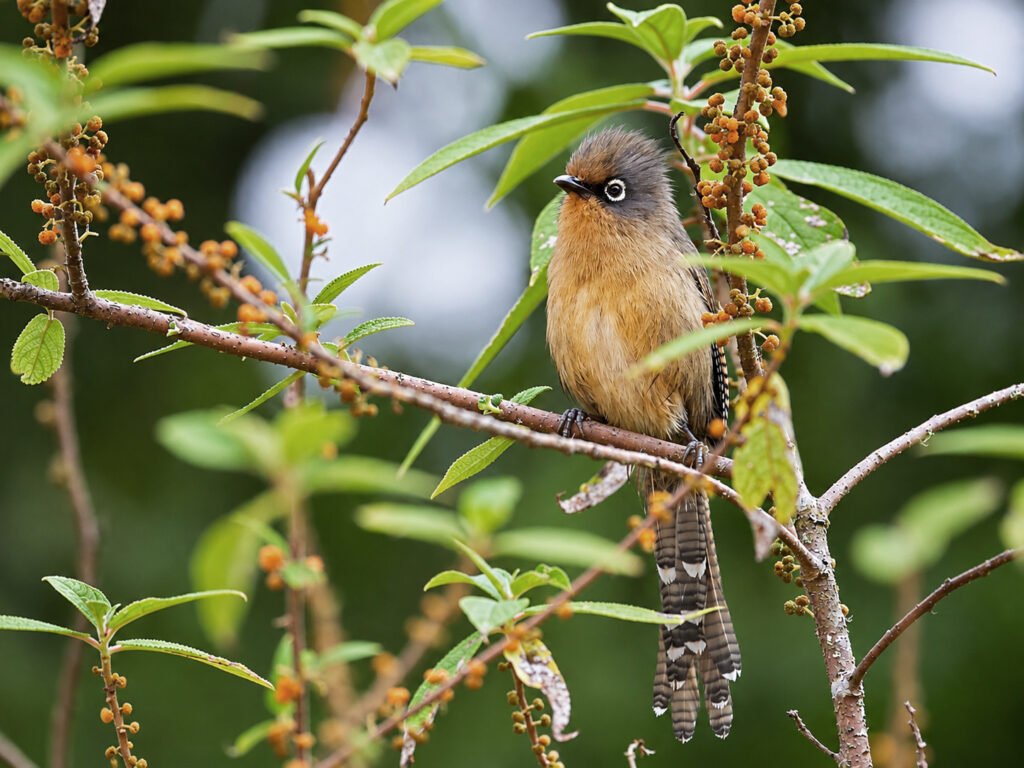
We spent the afternoon at a pair of stakeouts deep inside a forested gulley off the main track. Armed with our folding chairs, we waited in comfort and soon got point blank views of some real skulkers. A Pygmy Cupwing, a tiny round ‘golf-ball’ of a bird was first to arrive. Then a piercing high-pitched alerted us to the approach of Chestnut-headed Tesia, another tiny bird with a cute expression that’s notoriously hard to see. Joining this pair were a female Himalayan Bluetail, a Mountain Tailorbird, a White-tailed Robin, and a White-gorgetted Flycatcher. At the second stakeout we targeted Slaty-bellied Tesia, even skulkier than its Chestnut-headed cousin. It circled around us multiple times, but views were frustratingly limited, though a Lesser Shortwing was a good bird to see and a flock of Yellow-bellied Fairy Fantails kept us entertained with their acrobatic flycatching. Just as we left the trail our guide Nang located a calling Slaty-bellied Tesia very close by. We followed its movement by watching the swaying of the plant stems in landed on until it finally hopped out into the open, finally giving us all clear views. Elated, we ran into the Chestnut Thrushes again and got to photograph them in a more natural setting than at the feeding station.
We had hoped to spend the late afternoon at a higher point where Fire-tailed Sunbird could be found, but the rangers informed us a tree had fallen across the track making it impassible by vehicles. We decided to explore a little way up the trail on foot, but bird activity was unusually low with only another Rufous-gorgetted Flycatcher seen as well as a distant Collared Owlet heard. The most interesting find was the feathers of a predated Silver Pheasant – a tantalising sign of this elusive species. The views across to Myanmar at Doi Lang can be breathtaking, so we pulled over on the drive down at a viewpoint to take them in. It was magical moment looking over those forested hills and valleys soundtracks by the echoing calls of Great Barbets. Our last great birds of day came in the form of a flock of Chestnut Buntings which briefly perched beside our van before flying off.
Food at Tangerine Ville was consistently good, featuring a fusion of Thai and Chinese food. Several other birding groups were staying at the same time and there was a nice sense of kinship as we debriefed our days and shared information on where we’d seen particular species.
Day 5, 26th January – Doi Ang Khang
Another day and another part of this special mountain range; this time to Doi Ang Khang. While the other sites we visited are only really frequently by birders, Doi Ang Khang is popular with Thai holiday makers and weekend visitors. It hosts the Royal Project agricultural station, a mix of cultivated gardens and fruit rochards originally founded in the 1960s to replace the previous dominant trade on the hill – opium production. This made it the busiest location we visited up north, but also the most scenic. We began our birding early (when do we not?) at the ‘Chinese Cemetery’ area, looking for Brown-breasted Bulbul. Several Davison’s leaf Warblers were singing all around us, and another flock of Red-eyed Scimitar Babblers gave us the run around until finally showing, but no sign of the bulbuls. Nor did we ever find them, turning them into our first proper dip of an expected species on the tour. Luckily no one felt the loss too badly when weighed against the quality of unexpected birds like Scarlet Finches and the Himalayan Griffon yesterday.
Our next stop near the campsite was much more productive. Walking through the tall pines brought a pair of Ashy Drongos and a flock of Grey-chinned Minivets. We took in beautiful views down the valley from an outlook near the campsite, and the minivets soon came in closer, giving us brilliant views and photo opportunities. Soon a group of Short-billed Minivets began moving along the treetops in front, giving us a good comparison of their diagnostic wing pattern. The vivid yellow female were just as pretty as the crimson males.
We then made our way to a feeding station which hosted a cacophony of activity; Black-breasted Thrushes dominated the smaller Yunnan Fulvettas while Blue-winged Minlas stayed in the canopy. The best of all were a pair of Silver-eared Mesia, resplendent in a livery spun from noble metals and trimmed with scarlet like some medieval royals. A pair of Grey-winged Blackbirds took some patience to see well, so similar to our familiar European species but made notably more handsome by merit of a silver wing panel. An Eyebrowed Thrush flew over our heads then settled at the top of a pine and I quickly got it in the scope. In the foliage to the left we spotted a cute pair of Swinhoe’s White-eyes nestled closely together, not in the slightest bothered by the hyperactive Grey-headed Canary Flycatcher flittering around nearby. Two beautiful and long-tailed Black-throated Sunbirds appeared, purple heads glinting in the sun as if encrusted with amethysts.
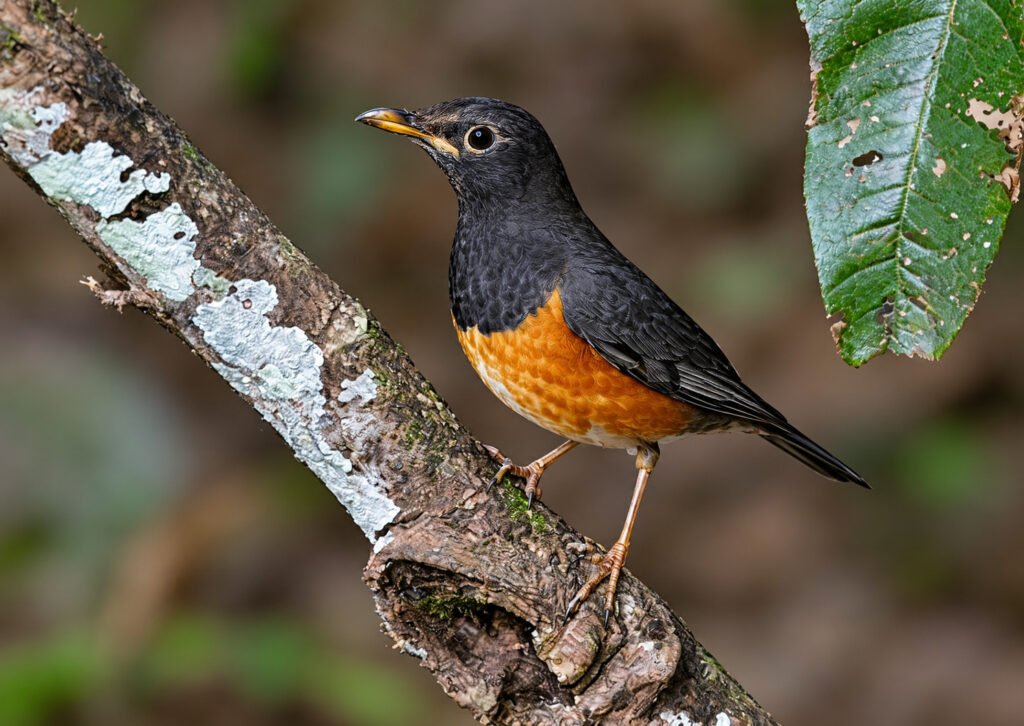
More thrushes followed in the area behind Wat Phra That, for whom the temple’s monks leave out food in accordance with Buddhist teachings. In addition to the species we’d already seen, a Grey-sided Thrush was an understated but handsome newcomer. In the tall trees above the feeding area, we spotted a Black-winged Cuckooshrike and a White-browed Shrike-Babbler which gave close views. A pair of Indian White-Eyes flicked into a bush where more Silver-eared Mesias were conveniently posing for our cameras. We all relished the opportunity for a bit of relaxed birding in the picturesque shadow of the temple.
We took our lunch at a beautiful restaurant at the Royal Agricultural station itself. We ordered then wandered around the exquisite gardens while we waited. The variety and colours of the flowers were breathtaking, a sea of pinks, crimson, sunshine yellows and deep ocean blues. Not to be outdone, sunbirds dripped off of the blossoming trees like hyperactive baubles. Our attention was pulled away by an objectively duller but none-the-less intriguing leaf warbler, which hung around long enough for us to nail as Greenish Warbler. Our dining was interrupted multiple times, first by a pair of Bar-winged Flycatcher Shrikes and then by more Mrs Gould’s Sunbirds including one that Nang identified as the uncommon ‘isolata’ subspecies by its plain yellow rather than scarlet breast. We were delayed setting off by the discovery of a Yellow-streaked Warbler just behind the carpark – a drab and somewhat awkward warbler that we were nonetheless happy to tick off so easily. A stop a little way up to explore a tree plantation put us right in the middle of a large flock of Swinhoe’s and the very attractive Chestnut-flanked White Eyes, which we followed with some haste as they ping-ponged around amongst the flowers. A Crested Honey Buzzard circled high overhead, probably the commonest raptor in Northern Thailand at this time of year.
The highest point we visited at Doi Angkhang was again populated by members of the Thai military guarding a border outpost. The novelty here was that on the next hill, over we could also see their opposite numbers on the Myanmar side going about their day at their own outpost, under their own flag. Two countries and cultures separated by a single valley brought the absurdities of global geopolitics and nationalism into starker relief than anywhere else I’d visited. There was further irony in our target bird – the Burmese Shrike – being named for its Myanmar heritage being seen on the Thai side of the border fence; immigration beaurocracy doesn’t trouble birds! We quickly found a pair amongst the pines who were happy to pose for photos, and they are a really attractive species. We then spent a bit of time perusing the hilltribe market stalls close by, where I purchased a dashing pair of elephant pants and thus fulfilled every cliché of English backpacking culture.
All in all, we’d had a good day on the mountain, but one of our key targets was still evading us. With the light getting low in the sky, we urgently wanted to try again for Giant Nuthatch, so we headed back to the campsite area. And then, piercing through sky; ‘peep, peep, peep’ rang out from a tall pine. We watched as this huge nuthatch hopped up the side of the tree before settling to continue its call. Massive, smart, rare, and having made us wait juuuust long enough for the jeopardy to set in, this is the kind of bird that sticks with you long after, and makes these kinds of trips so rewarding. We spent the last of the light enjoying Ang Khang’s spectacular views, against which another Burmese Shrike perched up, and a large flock of Cook’s Swifts rolled in overhead.
Day 6, 27th January – Semok Mongolian Horse Farm – Thatorn
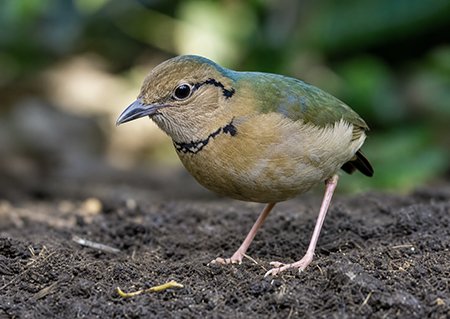
With our myriad successes with target birds so far, Nang had offered a novel opportunity at last night’s dinner; a Blue-naped Pitta, typically an extremely rare bird in Thailand, had recently become reliable at a hide in Chiang Rai, the next province over. This would mean a rearranging of the itinerary and missing out on a visit to Fang hot springs, but the group agreed that the trade-off was worth it for the chance at such a mythical bird. Our drive to the location was especially scenic, with some really stunning mountain vistas along the route. It was remarked a few times how nice it was to see how much virgin forest this region had so far retained. The sight of the hide had been a horse breeding farm, however, following the loss of most of their herd to disease, the owners had had to search for alternative sources of income. When they realised they had Blue-naped Pitta visiting their proporty, they decided to build a hide and improve the habitat nearby to encourage the birds to breed on the site. This is a positive example of the symbiotic relationship that can exist between tourism, conservation, and the local economy, and is a model being replicated across Asia.
Our vans were unfit for the winding horse tracks along the property, so we said goodbye to our drivers and began a pleasant walk to the hide. Butterflies of all different colours fluttered around the overgrown hedgerows, and a Long-tailed Minivet was the first bird of note. Again, minivets can be tricky to separate if you don’t get a clear view of the wing panel, so it was fortunate that they’re a fairly bold and conspicuous group. The path took us along the side of a lake, over which a pair of Grey-throated Martins skimmed for insects. This would be our only encounter with this species in the entire trip. A familiar Common Kingfisher shot across the water, uttering its distinctive call. Other common open country birds like Two-barred Warbler and Scarlet-backed Flowerpecker also featured, and a Common Iora called loudly from the canopy above.
After arriving at the hide we settled in to wait, and wait we would as our star bird decided to draw out the suspense. Our first prolonged views of White-rumped Shama were initially enough to keep us interested until it went down in our estimations by constantly harassing a Siberian Blue Robin trying to feed. Something skulking in the back really piqued our curiosity, as we realised, despite the broken views, that it displayed the sooty coloration and slightly absurd bill of a Dark-sided Thrush; a real prize. Then, emerging from the wings now that the warm-up act had gone on long enough, the female Blue-naped Pitta in all her rotund glory. She set about chowing down on the mealworms provided, giving us some pulse-raising views. After enough teasing, the Dark-sided Thrush now also came out into the open, and we were able to fire away happily apart from the intervals when that accursed Shama got too big for its boots. Another group of photographers arrived, so we were content to leave them the hide, thrilled that our gamble had paid off. Pittas really do have a special attraction for birders, and I’m pleased to report that this first species only set the tone for even more spectacular encounters that were to come. Nang hushed to us on the walk back that she had heard the call of a Chestnut-capped Babbler, a raucous but handsome inhabitant of wetlands and reedbeds. A pair of them responded instantly to playback and flitted in close – their striking red eyes piercing from a black-masked white face. The butterflies were out in full swing in the late morning sun.
We thanked the owners and departed the horse farm, stopping at a shaded restaurant to celebrate with some Chang beers. Some of us took the opportunity to try a traditional Thai desert called Lod Chong made with coconut sauce, rice noodles and kidney beans, though not everyone was convinced by the unusual assortment of textures. In these pleasant conditions we waited out the worst of the midday heat before heading to the Tha Ton vicinity. At an overlook, we set up scopes to scan along the river and quickly spotted a group of Small Pratincoles amongst an assortment of more common waders. These are soft-plumaged, cute-faced and aerially impressive birds, so I was as pleased as any of our guests to watch them. Two handsome ‘ocularis’ Pied Wagtails also drew the eye, a striking subspecies. In a scan of some nearby fields, we found little but a pair of Paddyfield Pipits and a Pied Bushchat, and so moved on.
Our last stop of the day was the Huai Mae Fang paddies, and we timed it to arrive right as bird activity was reaching its early evening peak. Huge flocks of Red Collared Doves looked spectacular dancing between their roosting trees, and a big group of Baya Weavers chattered endlessly in the bordering shrubs. We crept along the path towards three Red Avadavats, but they flushed and flew off into the distance. In symmetry with how our first day ended, it was a harrier that saw in the dusk. On this occasion, a male Eastern Marsh Harrier, looking majestic as it glided effortlessly above the paddy fields.
Day 7, 28th January – Doi Lang West
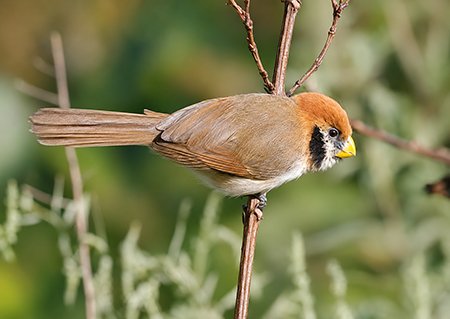
It was our last morning in this part of the north, which meant a second trip up to Doi Lang West to try to clean up the targets we had remaining. This time, we continued directly past the pheasant stakeout towards a spot known for Spot-breasted Parrotbills. The sun had barely begun to peek over the horizon when we found them, adding their odd ratcheting voices to the dawn chorus as they hopped amongst a thicket of straw-like stems. Soon afterwards, we followed some motion in the foliage whose source revealed itself as a group White-browed Laughingthrushes. This is a fairly common bird in much of China, but in Thailand, its range is limited to the very northernmost region. We continued along the road in the same manner as our previous trip here, hoping to find the kind of mixed flock that Himalayan Cutia often associate with. We located such a flock feeding in a group of tall evergreen trees, replete with Grey-chinned Minivets, a Pallas’s Warbler, yet more Black-backed Sibias, and best of all, a pair of Slender-billed Orioles. A Grey Treepie flew over our head, and then two Giant Nuthatches came into view as they worked their way along the pine trees. We spent a fair bit of time with the flock, hoping that the commotion might attract a Cutia, but no such luck. Eventually, they dispersed, and we continued on our way, connecting with a pair of Lesser Yellownapes for our troubles. We heard a Maroon Oriole and a Mountain Imperial Pigeon, but both stubbornly refused to come close enough to show.
With the morning dragging on, we decided to spend the remainder of our time staking out the “Oasis” to maximise our chances of seeing the Cutia. A little bit of intrepid exploring off the path behind it took us to a clearing with excellent views, surrounded by pine trees. Suddenly, a massive Mountain Hawk Eagle circled low right over our heads, spiking our adrenaline in the way only a large raptor can do. It seemed to us a bird perfectly suited to such majestic scenery. A Pale Blue Flycatcher appeared in the interim, before we started to notice signs of a new bird wave approaching. First were a family of White-browed Shrike Babbler, calling distinctively as they came in close. Next were Velvet-fronted Nuthatches, and then a large flock of Grey-headed Parrotbills. Finally, I picked out the chunky striped belly of a Himalayan Cutia moving through at real speed, but it waited for no man and was gone in a flash. We raced back down to the road and positioned ourselves directly underneath the spot we predicted the wave would appear from. Sure enough, the parrotbills began streaming past us. Quickly, we spotted two Cutias gleaning for insects along a branch, but unfortunately, they continued moving with the same haste as before, and most of our group got only brief glimpses before they disappeared again. A slightly unsatisfying meeting with this denizen of the Himalayan highlands wasn’t enough to dim our spirits – if it was always easy, birding in these wild and untamed locations would surely lose some of its appeal. With that, we had to call time on our visit to Doi Lang West and also on our stay in the far North which had treated us so well. We descended the mountain to enjoy a delicious lunch of Pad Thai, then loaded up our bags for the long drive south to our next destination, Thailand’s highest mountain: Doi Inthanon.
Driving from Fang down through Chiang Mai and on towards Doi Inthanon, we reached our base for the next three days, the scenic Touchstar Resort, which sits in the mountain’s foothills. A Grey-headed Canary Flycatcher greeted us on arrival and was seen each following day in the resort’s extensive gardens. The restaurant was a pleasant open-air affair soundtracked by the calls of frogs in the garden and served one of the better Thai green curries of the trip. A quick torchlit stroll around the grounds afterwards didn’t turn up any birds of note, so we turned in for the night.
Day 8, 29th January – Doi Inthanon
To kick off our first day exploring this huge and diverse mountain, we began at the Mueang Ang road (aka km. 13). The dry dipterocarp forest here is quite unique and makes it the best place for seeing several key species. At the turn off to the road, we parked over a stream to scan for Black-backed Forktail and quickly found one. It was sitting stationary on a large boulder, and through the scope far exceeded my previous views of this species at the same location in 2024. In an area of good habitat on the road, we spotted in succession Common Flameback, Greater Racquet-tailed Drongo, Red-billed Blue Magpie, a Purple Sunbird and a noisy group of the attractive white-faced subspecies of Eurasian Jay. Our key target, the vibrant green and black Black-headed Woodpecker then flew in close as if curious about our presence, before taking off just as quickly. We spent some more time along the road but did not locate the woodpecker again. Nor were any Collared Falconets on some of the perches they frequent here, so we pushed on to get up the mountain early, knowing we could return at the end of the day if needed.
The reason we’d left in such a hurry was to reach the summit area before it became overrun with visitors, a persistent problem in some areas of Doi Inthanon. A tiny Snowy-browed Flycatcher perched on the handrails by the little path to the summit marker, but it was on the Ang Ka trail that the birding really kicked into gear. This very well-maintained boardwalk passes through high-altitude cloud forest, the trees dripping with epiphytes, and as such has an atmosphere unlike anywhere else in Thailand. We hadn’t had to leave the trailhead before we found four Rufous-Throated Partridges scraping away the leaf litter as they foraged. Arborophila partridges are, to a species, beautifully marked birds, and these with their slaty-blue bellies and black and ochre dappled necks are among the best of them. I then played in a Buff-barred Warbler which responded instantly, coming within a few meters of us.
Along the trail we were beset on all sides by brilliant birds; Rufous-winged Fulvettas and Chestnut-tailed Minlas abounded; a striking cobalt male Himalayan Bluetail left a much greater impression than the females we’d seen in the far north; and the now familiar Mrs Gould’s Sunbirds were joined by the dazzling Green-tailed Sunbird. Found only on Doi Inthanon in Thailand, this population represents its own subspecies. Davison’s Leaf Warbler were incredibly common here, as were Blyth’s Leaf Warblers, another species almost exclusively confined to this part of Doi Inthanon in Thailand. At a clearing we watched the sunbirds flick around and an Eyebrowed Thrush feeding at a fruiting tree. Several orchids provided interest for the more botanically minded among us. Near the back of the loop a large bird wave rolled in consisting of the ostentatious Yellow-cheeked Tits, the plainer Yellow-browed Tits, a Yellow-bellied Fairy Fantail, and at least ten Chestnut-flanked White-eyes. Trailing them was an Ashy-throated Warbler, one of the most (thankfully) distinctive Phylloscopus warblers. By this point the trail was getting overrun with foot traffic, so we left to patronise some of the stalls selling coffees and donuts and peruse the visitors centre.
Our lunch spot was typically scenic, this one besides a river that was attracting the best butterfly diversity yet seen on the trip. We momentarily forgot that we were self-respecting birders when a jaw-droppingly large and attractive Paris Peacock Swallowtail took our collective breaths away. Birding purists shouldn’t sneer though, because it was while photographing more butterflies after lunch that we spotted a Collared Falconet. It perched up in a dead tree above the restaurant, and caused a mad dash to grab our scopes. Orcilla won that particular footrace, giving us crystal clear views of this adorably tiny raptor.
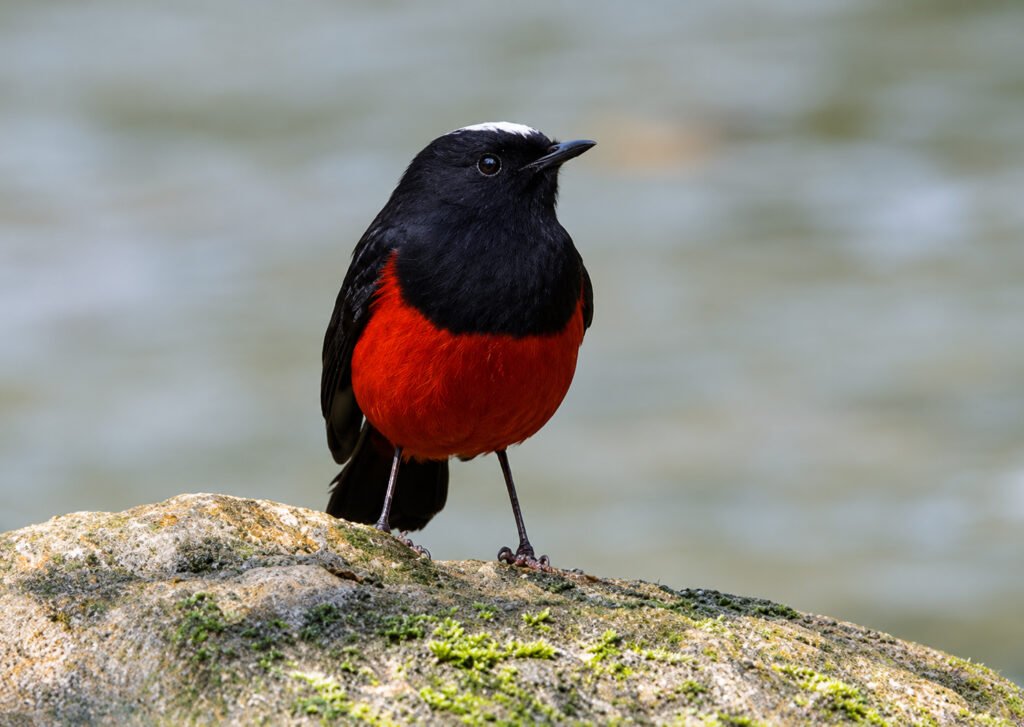
Next, we went to check out a location famous for two visiting redstarts. At an attractive mossy river bank, our first target was already waiting for us. This was the male White-capped Redstart, a water-associated species that with its brick-red underparts, black cowl and white crown is one of the most understatedly handsome birds in all of Thailand. Remarkably personable, he perched on a rock in the middle of the stream and allowed great photo opportunities. While photographing him, a Slaty-backed Forktail gave us brief views as it shot past us down the river. Unfortunately, neither searching in the direction it flew, nor waiting patiently for it to come back yielded any results. A stroll upstream brought us our first Black-naped Monarch, always a lovely bird in its powder-blue regalia, and on return the White-capped Redstart had been joined by our second target, the much smaller Plumbeous Water-Redstart. Nang heard anAsian Barred Owlet calling in the canopy, but searching yielded no results and it soon went quiet in the heat of the muggy afternoon
Having had not encountered any with Ashy Woodpigeons at the summit area, we ventured back up the mountain to try a viewpoint from where I had seen dozens flying to roost on a previous trip. We had no such luck this time, but were instead rewarded with the appearance of a female Chestnut-bellied Rock Thrush, our last good bird of the day.
Day 9, 30th January – Doi Inthanon
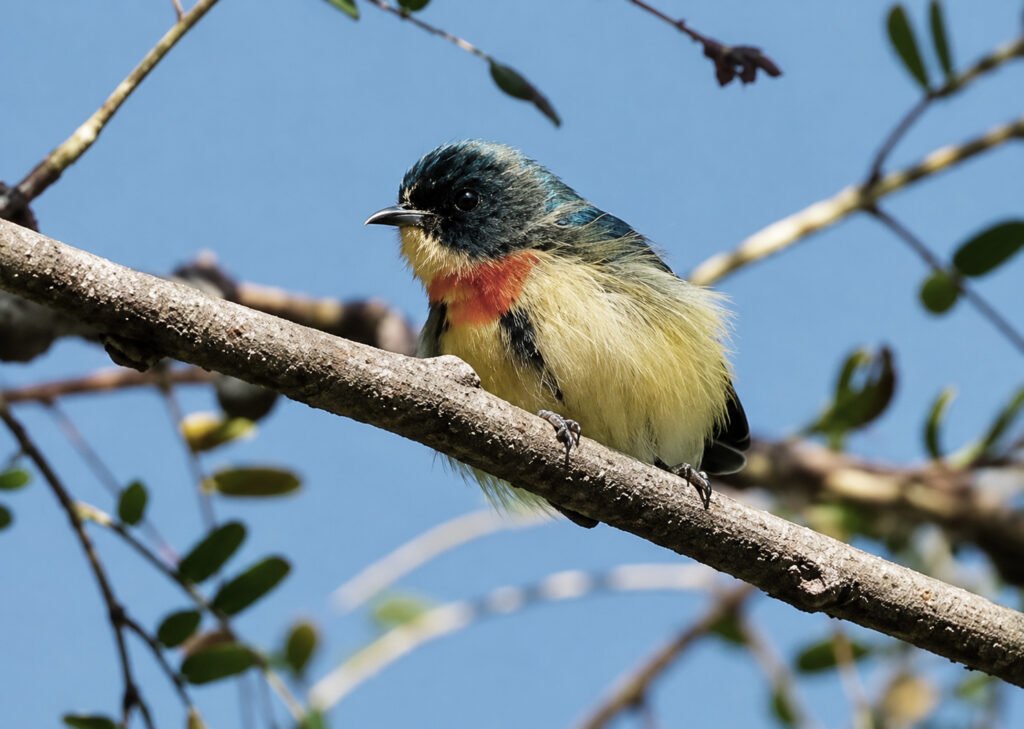
We spent the next morning exploring a different side of the mountain. The patch of forest Nang took us too was incredibly active, and we the first quarter of an hour to peruse the contents of a big mixed flock surrounding us. In amongst the collection of warblers and fulvettas that we’d encountered many times already, a pair of cute Little Pied Flycatchers and a Fire-breasted Flowerpecker were the highlights. We’d heard Maroon Orioles calling on several occasions during our stay in the north, so it felt hard fought and well-earned when we finally got good views of a pair flying over us here. Peering through some thick foliage yielded a group of Wedge-tailed Green Pigeons settled on a branch. A clearing further along the road was the staging ground for our meeting with a curious Hill Prinia, and I excitedly called out as a Crested Tree-Swift flew over; Hemiprocne being a family tick for most of our group. Back in the woods, an Asian Emerald Cuckoo then landed close in front of us, though the harsh backlighting robbed some of the brilliance of its plumage.
Our lunchtime scenery reached new heights this day as we relaxed and ate in the shadow of the spectacular Wachirathan Waterfall. Birdwing butterflies coasting above on the spray-filled wind were delightful, and mist thrown up by the powerful cascades conjured rainbows in the air. Our afternoon’s leisure was taken at a restricted access hide, offering the best chances at a number of the mountain’s biggest skulkers. Grey-eyed and Puff-throated Bulbuls were conspicuous, a Buff-breasted Babbler patrolled at the back, and the plain but active Brown-cheeked Fulvettas swarmed the feeders in numbers. Adding more colour to a rather muddy ensemble were a male Siberian Blue Robin, and a Little Spiderhunter with its comically oversized bill. The group elected to take the opportunity for an earlier evening, so we departed back down to our verdant accommodation.
Day 10, 31st January – Doi Inthanon
As it would be unconscionable to miss out on the rare woodpigeon action, we knew had to get back up to the top of Doi Inthanon by exactly 7am for a rendezvous with some speckly characters. Reaching the spot, we fanned out with our scopes until I discovered our targets; a pair of Speckled Woodpigeons, members of a flock known for sunning themselves here in the early morning. We pointed them out to a group of young Danish birders who’d become friendly with in our time on the mountain, then moved on to watch another group of Wedge-tailed Green Pigeons feeding on fruit.
We then ventured back down to the famous KM 34.5 ‘Mae Oum’ area. We were quickly beset by our biggest bird-wave yet, which contained a bit of a greatest-hits collection of montane Thai avifauna we were familiar with, while adding species that had previously evaded us like Clicking Shrike-Babbler and Speckled Piculet. When the wave dissipated and activity slowed, another hidden feeding station hidden below a rather steep track gave up the goods in the form of Himalayan and Lesser Shortwings, and better looks at Snowy-browed Flycatcher, Pygmy Cupwing and Slaty-bellied Tesias. This track’s steepness made it one of the few sites that strained accessibility, but with a slow and steady approach we conquered it with minimal fuss. Along the path we spotted a wonderful specimen of Himalayan Sapria, a very rare parasitic plant related to the famous Rafflesias of Borneo and Sumatra. I had good memories of the more open, piney area towards the end of the Mae Ouam trail, and on this visit it gave us a pair each of Stripe-breasted and (more excitingly) Grey-capped Pygmy Woodpeckers, two Black Bulbuls and great views of a Streaked Spiderhunter.
While we waited out the period of lowest activity, Nang took us to a browse the fresh produce sold by the hilltribe tribe people at a large marketplace near Ban Khun Klang village. Nang always had her eyes peeled for quality greens, and would get the hotel kitchen to incorporate into our evening meal which added a personal touch to some already delicious dining.
We took stock of any potential species remaining to us on the mountain, and decided to target White-headed Bulbul, a striking and uncharacteristically dainty (as well as highly range-restricted) bulbul that we’d yet to turn up. Our first attempt at the Orchid Conservation Project was a bust when it turned out to be closed, though we did add Blue Rock Thrush to our trip list by peering over the Project’s drystone wall in hope more than expectation. We quickly changed tact and, at some immaculately kept gardens near the government offices, found a pair of White-headed Bulbuls, with a supporting cast of five Black Bulbuls feeding on some luminous red flowers, another Streaked Spiderhunter, and a pair of the absurdly long-tailed Green Malkoha. Nang took us to spend the last hour of sunlight at an area crisscrossed by streams below a picturesque tall waterfall, where the group got views of a resplendent male Rufous-bellied Niltava, having until this point only seen the notably drabber female.
Day 11, 1st February – Doi Inthanon to Bangkok
Our last morning in Doi Inthanon before our flight south was spent at the nearby Blossom-headed Parakeet tower. Just a five-minute drive from our accommodation we found ourselves ascending the tower on the edge of an area of regenerating dry dipterocarp woodland. As the sun rose Green Peafowl began emerging in treetops from which several males began calling. Flowering trees here usually atract many birds and this occasion was no exception with a wide variety of species at close quarters. The hoped-for Blossom-headed Parakeets were somewhat elusive although we did see one individual of this colourful species. The flowers provided an attractive food resource for a flock of ten Chestnut-tailed Starlings, a Black-hooded Oriole and a couple of flambouyant Golden-fronted Leafbirds. Other new birds for the trip included Yellow-vented Flowerpecker and two Red Junglefowl. After a few hours here it was time to move on, concluding the northern section of our Thailand birding tour, by transferring to Chiang Mai airport and our flight down south to the kaleidoscope of new and old, peace and frenzy, colour, smells, sounds and tastes that is Bangkok. As a last hurrah for the north, we stopped briefly at the Doi Lo paddies where we picked up Grey-breasted Prinia and a pair of elegant Black-winged Kites as they circled serenely above the heat-haze.
Apart from a moment of madness from our local driver (who apparently decided we simply had to see the ancient walls of Chiang Mai again before departing) meaning we got to the airport behind schedule, the rest of the journey was smooth, and it was enjoyable watching the agricultural fields of Thailand’s heartland slip past below us for the hour long flight. We touched down in Bangkok, made our way to the blissfully airconditioned lobby of the Amari Don Mueang hotel, and settled in to enjoy a well-earned afternoon of cocktails by the pool, to refresh ourselves and prepare for the next leg of our trip.
Day 12, 2nd February – Khok Kham to Kaeng Krachan
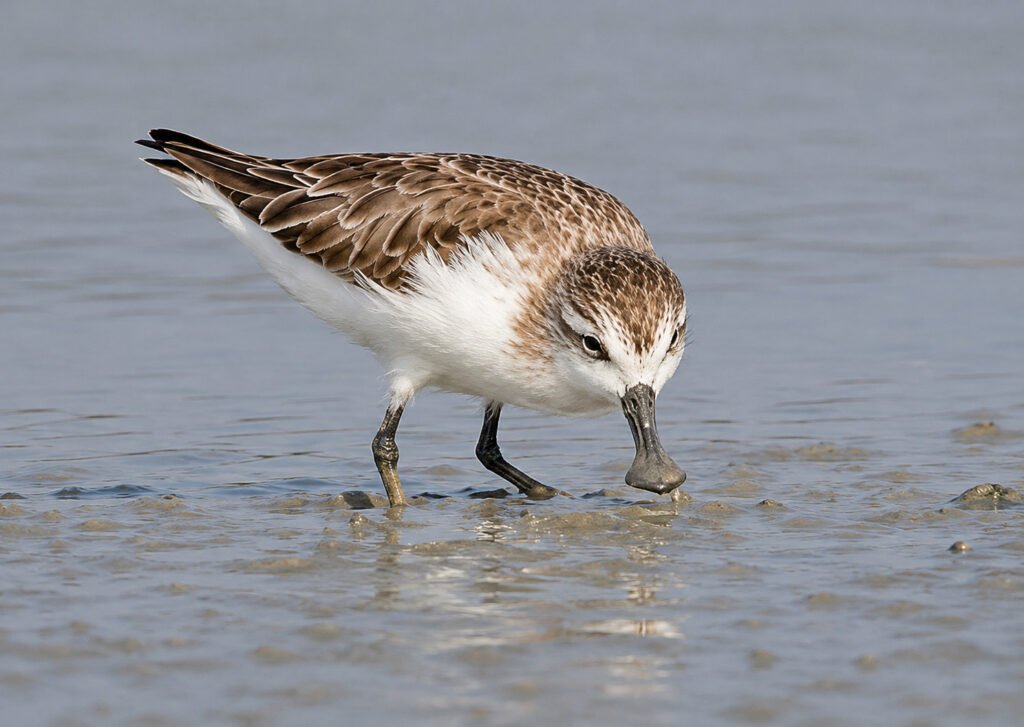
There are birds. There are beautiful, interesting, unique and rare birds… and then there are the birds that you cross continents for. Birds that have for one reason or another have come to define what a country represents to the discerning eye. Birds with a certain je ne sais quoi. Whose presence or lack thereof can define an entire trip. This is the day we met one such bird; the Spoon-billed Sandpiper. An iconic species of the whole region, and of Thailand in particular since it likely the best and most reliable place to see it. The Spoon-billed Sandpiper is a tiny, critically endangered sandpiper with one of the most remarkable beak morphologies evolution has yet conjured up. Pushed to the brink at its breeding grounds in China and Russia as more and more wetland is lost to development, this species’ continued survival is by no means a foregone conclusion. A few coastal sites around the gulf of Thailand play a critically important role as winter feeding grounds for this species, and we had an entire morning to spend at one such site – Khok Kham.
As we drove further and further southwest through Bangkok’s radiating urban sprawl, the birds were our first sign that we were approaching the coast. First an Oriental Darter flying over the van, then a flock of Brown-headed Gulls. Soon the air took on the salty tang of the ocean. We drove past the acres of salt farms that make up this area, covered corner to corner with wading birds, and our pulses quickened. It was with some haste that we parked up, assembled the scopes and began scanning. Amongst the throngs of Tibetan Sand Plovers, Red-necked Stints, Broad-billed and Curlew Sandpipers that made up the overwhelming bulk of the flocks, your eyes quickly acclimatized to spot out the aberrant shapes – the larger and more heavily-billed silhouette of three Greater Sand Plovers, or the balletic poise of a pair of Marsh Sandpipers. The flyovers of Little Cormorants or Caspian Terns, new birds for our trip, were at this point barely welcomed distractions from our main search for the elusive ‘Spoony.’ With no sign, nor for the several other groups of birders also there, our group ventured back to the small visitors’ centre area for breakfast while I stayed behind to scan – quietly nursing the fantasy of finding our target and graciously accepting the adulations that would surely entail. That fantasy was quickly shattered by the excited gesturing of the group 50 meters to my left, but I wasn’t about to look a gift horse in the mouth. I signalled to Nang that this Breakfast Club was over before it had begun, and everyone high-tailed it back across to the group who had found the Spoon-billed Sandpiper. A friend and professional acquaintance of Nang’s, their guide was exceptionally gracious in helping our whole group to get onto the bird he’d spotted. And there it was, one of maybe only for hundred left in the world, bobbing its vertically compressed bill rapidly up and down for the life-sustaining soft-bodied ephemera of the salt-farm ecosystem. We enjoyed wonderful scope-views for an extended period of time, but sensing the gravity of seeing such an imperilled animal, no one felt particularly inclined to push our lucks for the sake of better photos, and thereby risk flushing the bird. Eventually, it left of its own accord, departing as one tiny bird among thousands of other waders as they simultaneously took wing to make great undulating waves in the sky; the way light ripples on the surface of a pool.
The rest of the day passed with a hazy quality, punctuated by short vignettes overexposed by the heady Thai sun. In a patch of flooded mangroves, a Malaysian Pied Fantail cocked its tailed and sang above the primordial staring eyes of giant mudskippers. Collared Kingfishers ripped through the air with their piercing laughter. In a temple where White-nest Swiftlets decorated the walls with their droppings, Nang spoke to us about her relationship to her religion, the ways the messages of Buddhism permeate and inform her daily life. A pair of Little Terns dancing on the wind were the only sign of life against the industrial shipping infrastructure of the Bay of Bangkok. Taking lunch beside a river, an Asian Brown Flycatcher and a Javan Pond Heron perched in the opposite reedbed. Archerfish patrolled below us for scraps, though I doubt they would have touched the massive egg soufflé that arrived as the centrepiece to our meal, wobbling like the Hindenburg in a strong gale. We had 20 baht ice-creams to wash it down, and some members of the group were very in demand as models for the ice-cream seller’s family – I maintain that if those photos are to appear in advertising, we should have negotiated a free ice-cream or two. At Phraek Nam Daeng, Grey-headed Lapwings and Blue-tailed Bee-eaters were both upstaged by the sight of the shrimp fishermen going about their daily work.
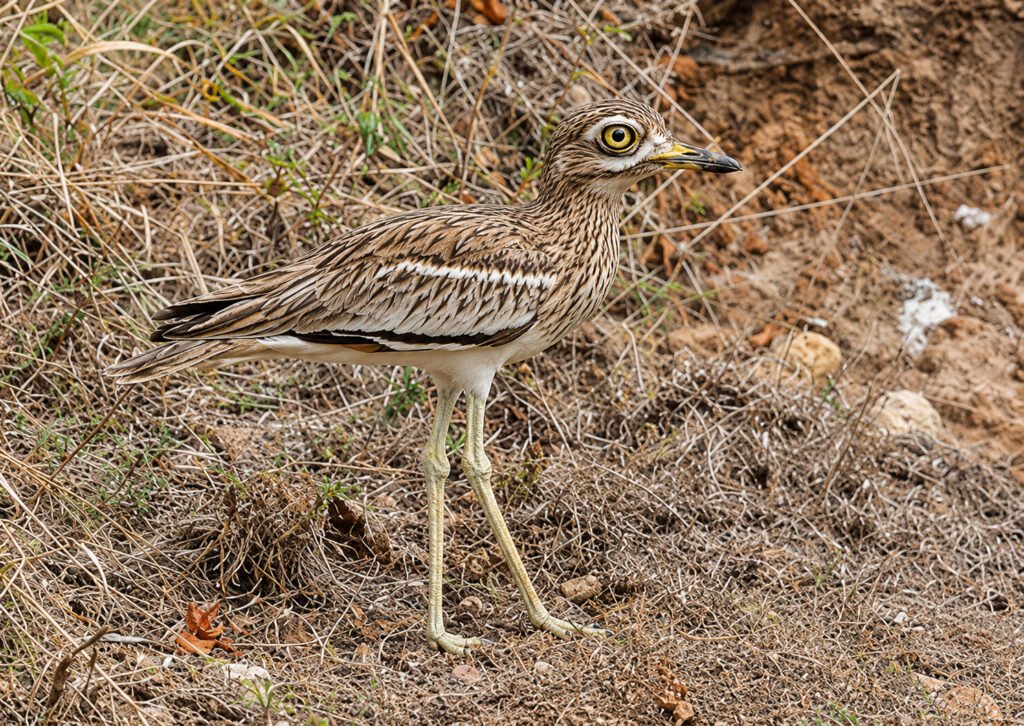
Our last stop of the journey south was a known stakeout, just beside the road, for Indian Thick-knee. Brilliantly camouflaged when they sat unmoving on the barren earth, their beady yellow eye was the first thing you noticed, and only then would the rest of their form pop sharply into focus. In around ten minutes here, we also found Hair-crested Drongos and a pair of Common Hoopoe, a familiar bird in unfamiliar surroundings. A short drive further through some beautiful landscapes of forest punctuated by limestone karsts, and we arrived at Samarn Bird Camp, our base camp to discover the hidden jewels and untouched jungles of Kaeng Krachan National Park.
Day 13, 3rd February – Kaeng Krachan
Kaeng Krachan is the largest national park in Thailand, with an area of nearly 3,000km2, and the vast majority of it is completely untouched. Biodiversity is thick here, and the park is impregnated with a sense of true wildness that’s becoming vanishingly rare the world over. In a pair of 4×4 trucks, the slow trundle up the park’s dusty track began amidst a still, golden morning. Perhaps it was the views of untouched jungle that instilled a magical quality, or perhaps it was merely the anticipation of our next collection of lifers, but I felt as though the group was subconsciously holding its breath.
A pair of great hornbills in a lazy take-off were the first sighting to pay off that tension; and is there a more postcard-worthy match of bird with setting to be found in all the jungles of Asia? Chilly given its altitude, Panoen Thung campsite was host to our morning’s birding, sitting at the highest reaches of the accessible track. The centrepiece of this area is a massive but low-hanging fruiting tree, under which’s canopy we stood and waited for the action to come to us. Immediately, some of the most infamously neck-straining canopy dwellers of the region stopped in to feed at point blank range. Blue-throated Barbets gave us by far our best views of this species, joined by their tiny Blue-eared cousins. Joyously, a cobalt-headed Great Barbet stopped by, putting an end to the long tease of a species whose distant call had been a constant, taunting, companion up north. Accompanying the barbet bonanza were Ochraceous, Olive (?, eBird taxonomy), Ashy, and Flavescent Bulbuls, a Yellow-vented Flowerpecker, the bedazzling male Asian Fairy-Bluebird, and most excitingly Striated Yuhina; a tricky and sought after species.
The thickly jungled border of Thailand and Myanmar stretched out behind to make a dazzling viewpoint. Reverberating through the valley came the echoing calls of White-handed Gibbons, and we spotted a golden-morphed individual moving through the canopy. Closer, a family group of Dusky Langurs moved towards us and laid claim to our tree’s nectar-filled bounty. Our attentions turned away on the arrival of a Great Hornbill, which settled in a tree across the path and began to gorge itself on ripe fruits, utterly unperturbed by the half dozen or so telephoto lenses promptly turned its way.
Knowing that this arboreal cornucopia would continue to attract activity throughout the day, we ventured a little further along the track to check out some more viewpoints. A pair of tiny Himalayan Swiftlets graced the first, and a Crested Goshawk flew over several times before we pulled over beside the track to grab some shots of a Dark-sided Flycatcher. Returning to area around the fruiting tree, we added Yellow-bellied Warbler, a vibrant lemon little songbird with a clean grey head that I remembered fondly from visiting the Malaysian highlands in 2024. High pitched and distinctly psittaciforme-ringing preceded a flock of Vernal Hanging Parrots shooting past, an acid green little parrot with a cute red bill. The group circled several times and eventually settled briefly in one of the taller trees in front of the toilet block, and down the valley, a Black-naped Oriole sung it’s mournful whistled notes.
We doubled back on ourselves to get into some thicker jungle and target our biggest goal up here at the top of the park… a flock of Hair-crested Drongos were a false alarm, but we soon found a pair of the bizarre Ratchet-tailed Treepies, whose entire range in Thailand is limited to this highest altitude of this national park. They vanished as soon as they had arrived, turning that medieval torture implement of a tail to us and ducking away into the thick jungle. We didn’t find them again, but instead turned up a Large Woodshrike which Maralin spotted as it gleaned for arthropods. Nang’s connections with the wider birding community paid dividends again when she received a tip off for the location of a roosting Grey Nightjar spotted earlier that same day. Like many nightjars this is a migratory species and only in the country for a few months a year, so it was a privilege to get walk-away views of such an intricately patterned and cryptic nightbird.
The 29km area of Kaeng Krachan is well known as a particular birdy spot, so that’s where we decided to spend our afternoon. Initially quiet, the first sign of activity was a Sulphur-bellied Warbler flitting across the path. It heralded a large bird wave, with several dozen of the species dominating a flock that also included Yellow-bellied warblers. Best by far were a small flock of Collared Babblers skulking in the foliage below, an atypical babbler with a ghostly white visage. We followed them down the track until everyone had obtained a good view, leading us to a Hume’s White-Eye. A pair of Rusty-Cheeked Hornbills then crashed into the canopy, and we spent some time finding the best angles to view them. Our 4×4 driver then called out in excitement, with his eagle eyes he had found a Red-headed Trogon, high up the mountain’s slope above us. We had several views of it as it flicked between trees, but it refused to settle in the open. Knowing we had better opportunities to see this species ahead of us, we let it be when Nang heard a pair of calling Yellow-vented Pigeon which showed in flight.
This quick succession of high-quality species would take some beating, and luckily Nang knew just the place… with the light fading we got into place to view the roost of one of Kaeng Kratchan’s most mythical animals. Crouching and craning our necks, we peered into the evening gloom; hidden amongst a thicket of branches, the unmistakable form of the White-Fronted Scops Owl came into focus. In such a large family as the scops-owls where many species more or less resemble one another, it has a haunting beauty all of its own. A bone white face framing wine-dark eyes, wings like bark painted in red ochre. Rare and little known to science, this is the only place in the world it can reliably be found. It was hard to pull ourselves away but eventually the lack of light dictated that we return to camp. Several views of Large-tailed Nightjars illuminated in our headlamps rounded off the day in emphatic style.
Day 14, 4th February – Kaeng Krachan
After exploring the upper elevation of the park yesterday, we turned our focus to the low and middle sections. Beginning our birding in dry Dipterocarp habitat, a group of Greater Flamebacks were immediately conspicuous moving along the bare treetops. Coraciidae were well represented by an Oriental Dollarbird and two Indochinese Rollers which perched nicely for the scopes, as did a flock of Thick-billed Green Pigeons. Oriental Pied Hornbill were common and both these and Great Hornbills were seen throughout the day in various locations. Our first of four Orange-breasted Trogons was seen as we looked out over a large pond, beside which a shining male Hainan Blue Flycatcher was flitting about – the brilliant white of its breast distinctive compared to its many blue-and-orange relatives that we’d seen thus far. A patch of flowering bamboo allowed us to spot several Pin-tailed Parrotfinches, a tricky and beautiful bird that’s infamously hard to track down except when it congregates to feed on this one food-source. In the same spot, a Ruby-cheeked Sunbird also delighted with its delicate iridescent patterning and distinctly short bill, while large group of White-rumped Munia dominated the flock.
Continuing through to the areas of thicker jungle, we rendezvoused back with yesterday’s White-fronted Scops owl. A nice aspect of this tour was there was as much interest in enjoying and appreciating the birds we saw as there was in seeking new species to tick off, so we could gladly afford to spend more time in the presence of such a special bird. While exploring nearby we found a White-bellied Erpornis, and another Orange-breasted Trogon perched up beautifully to allow us some great photo opportunities – much more typical trogon behaviour than yesterday’s hyperactive red-head! In a winding footpath through some thick forest, we spotted our only Rufous-fronted Babbler of the trip. Admittedly the clusters of violently pink Sapria Ram, another rare parasitic flower were arguably more striking than this subtle forest skulker. Rounding a corner, we flushed a bizarre looking dark bird with spotted wings. Creeping up slowly on where it had landed, we found it to be an immature Large Hawk Cuckoo, one of the fascinating Hierococcyx genus of cuckoos that have evolved a reasonable level of mimicry of small raptors like the Shikra.
Pushing up higher into the park, we arrived at the Heart-spotted Woodpecker stakeout, and were treated to two visits of this striking and tiny woodpecker delivering food to its nest. A Blue-bearded Bee-eater briefly flew over while we waited. We then returned down to the stream crossing area to target more deep jungle species. In and around this area, we spotted the splendid billowing tail of a Blythe’s Paradise Flycatcher which kept returning to the same tree, a flock of noisy Pin-striped Tit-Babblers, a Great Iora, a couple of Black-naped Monarchs, Black-winged Cuckooshrikes, a Speckled Piculet and a small flock of Chestnut-headed Bee-eaters. An exploratory wander along a small side trail brought us some real gems, firstly the mad-looking, plum coloured Banded Broadbill; an iconic jungle species of Sundaland with a cartoonish blue bill. Immediately beside it was the intricately patterned Buff-rumped Woodpecker; never a particularly easy species to find, Kaeng Krachan represents the northernmost extent of its global range. Back on the main trail we saw some interesting herpetofauna in the forms of an Oriental Vine Snake and Clouded Monitor Lizard.
While others rested in the shade, Dave and I saw out the midday lull in bird activity by photographing some of the spectacular diversity of butterflies which congregate around the streams and saltlicks in this area in their hundreds. The colours and numbers here are really something. With the heat and humidity of the day continuing to rise, some of the group understandably decided to sit out the afternoon’s birding and journeyed back to our accommodation, while the rest of us pushed on in search of more targets.
At a watery area we found more nice birds but nothing we hadn’t already seen: a pair of Blyth’s Paradise-Flycatchers, a small flock of Sultan Tits and a Vernal Hanging Parrot perched up high above us. The calling of a Grey Peacock Pheasant led us to follow another winding path through the dense jungle, and though the pheasant didn’t show itself we had a date with this species at a hide the next day so weren’t too perturbed. In fact, following this trail was one of the best decisions we made, as on reaching an area of sloping bank and low vegetation, the unmistakable whipping call of a Blue Pitta rang out at close range. Cue one of this trip’s heart-stopping highlights as the glowing fiery brow and exquisite cobalt of a male Blue Pitta sprung into full view. Hearts pounding, we snapped whatever shots we could as it continued on its way, bounding up and over the bank before disappearing back into the forests gloom. An iconic bird of Thailand and one of the most beautiful pittas in the family, we’d already booked a hide to target this species so that the whole group would have an excellent chance of seeing it. But I’ve always thought there’s nothing quite like finding a pitta in the wild, and what a reward for those who stuck it out until the end of the day.
These rewards wouldn’t stop though, because after more enchanting encounters with more Trogons and getting better views of a dazzling Asian Emerald Cuckoo, we left the thickest jungle of the park to search for Black-and-Red Broadbill. We located a pair of these Sundaic stunners by their loud and scratching song, and had extensive views in which to appreciate their distinctive wine-red and black plumage. Careful managing of our timings paid dividends as we arrived at particular tree just as our final target, the diminutive and cute Black-thighed Falconet, made its way to roost. It made several passes before settling, moving among different trees and thus giving us excellent scope and flight views of this tiny predator, and we stayed watching it until the last of the light was drawn from the sky.
Day 15, 5th February – Kaeng Krachan
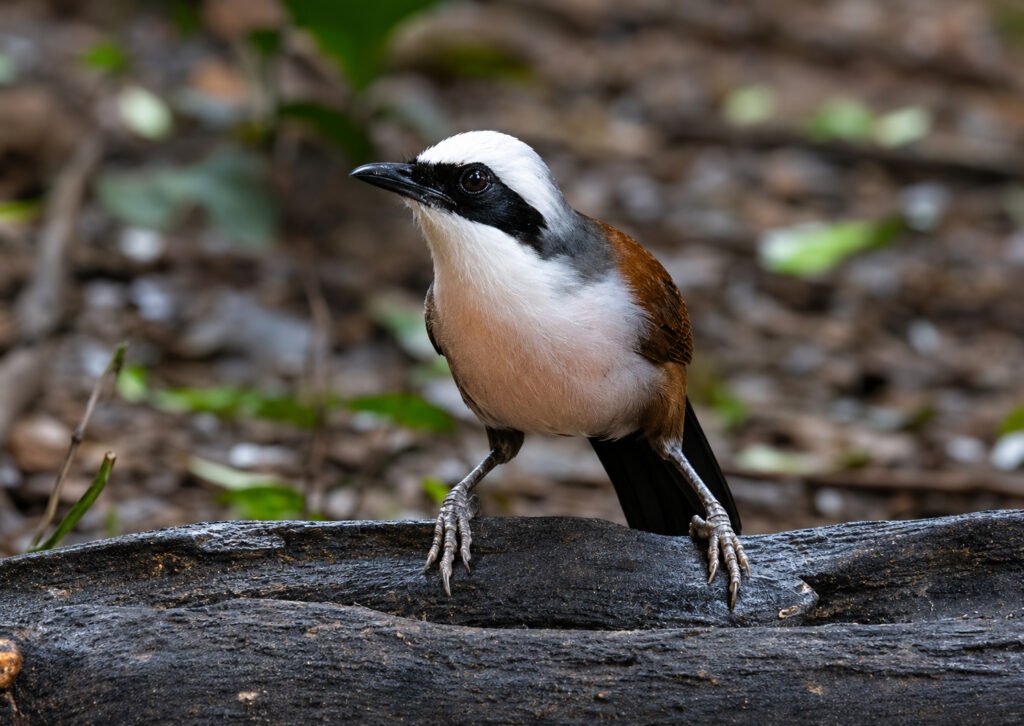
Today we were booked into a relaxing session at ‘Mr Bird’s’ famous hide in the foothills surrounding the park, providing an excellent opportunity to target some skittish and skulky ground birds. Approaching the hide, we were welcomed by a Black-capped Kingfisher overlooking a stream, and a Thick-billed Warbler in the rushes behind the makeshift toilet block. We took our seats and settled in, waiting for sunlight to start piercing the gloom of the forest floor. Soon a cacophonic mix of birds began attending the various food stations provided, with White-crested, Lesser and Greater-necklaced Laughingthrushes being the most boisterous and noisy. Joining them were svelt,sapphire-eyed Racket-tailed Treepies, two large woodpeckers in Greater-Yellownapes and Common Flameback; not to mention the usual assortment of bulbuls, shamas and fulvettas. A large male Red Junglefowl was the first Phasianid to arrive, a sign of things to come. A rather sorry looking Green-eared Barbet missing most of its upper mandible returned repeatedly throughout the day, apparently surviving its injury by the grace of this cornucopia laid out by Mr Bird. The morning’s first moment of great excitement game when a Crested Goshawk crashed through the canopy to attack a bulbul. Excitement turned to dismay when we were told that one of our targets, the Ferruginous Partridge, had not been seen in over a week following a close call with this grey ghost of the forest. Luckily everything else would cooperate to a greater or lesser extent, and a pair of Grey Peacock-Pheasants entered the stage, the gem-studded tail of the male trailing like a bridal train behind him. Not long after came a pair of Bar-backed Partridges, equally well-marked cousins of the Rufous-throated Partridges that we’d seen on Doi Inthanon.
As we took our lunch a charming pair of Puff-throated Babblers foraged practically at our feet, clearly habituated by the mealworms Mr Bird provided. Back in the hide, a low gurgled whistle excited Nang and she told us to get our cameras ready, as this signalled the arrived of two Large Scimitar Babbler; an impressive and prehistoric looking jungle inhabitant. More excellent birds ensued with the arrival of a group of Kalij Pheasants in their shining silver-backed morph, and we added Chinese Blue-Flycatcher ever-growing ‘Cyornis’ list. Our last target was rather testing our patience. When I pointed out ‘Bar-backed Partridge’ in the book and our guests were treated to the muddy illustration of a fairly drab brown bird, I could sense the desire to stick it out starting to wane. But just as we were about to declare defeat, three of the things decided to finally turn up, impressing than their intricate barred and spotty patterning far more than their pictorial counterparts.
After sitting in a hide all day, we took the evening to go looking for a pair of nightbirds. The reeling songs of Indian Nightjars surrounded us from the moment we left the van, and one quickly flashed in front of our torches as it hawked over an arid area of grassland and shrubs. Continuing down a side-path through a sparsely wooded copse, it took a fair amount of work to track down an Oriental Scops Owl but eventually the tiny nocturnal predator perched out in our torchlight, yellow eyes aglow.
Day 16, 6th February – Blue Pitta hide & Ban Kum Aquaculture
As only half our number had been with us when we found our Blue Pitta, we visited another hide this morning to give everyone a good chance of ticking this iconic bird. Soon enough, a female Blue Pitta appeared, bounding down into the clearing to shuffle around in the leaf-litter. Many of the other species at this hide were shared with yesterday’s, but a lemon-yellow Alstrom’s Warbler and a Grey-headed Woodpecker were welcome new additions. A brief final visit to the park’s foothills turned up three Pale-legged Leaf Warblers and a close encounter with another family of gibbons but little else we hadn’t seen before. We hit the road, saying goodbye to Kaeng Krachan’s vast and ancient forests, and made for the coast.
Laem Phak Bia’s luxurious seafront iTara Resort was as big a change from the humid jungles of the interior as you could reasonably imagine. You could hardly blame those of our number who preferred to indulge in its poolside cocktails and bespoke spa treatments over another birding outing. For the rest of us though, our close proximity to a number of high-quality aquacultural ponds provided an unmissable opportunity to find some new waterbirds. A short walk through the pools and paddies of Ban Kum netted us in quick succession: both Pheasant-tailed and Bronze-winged Jacanas, Grey-headed Swamphen, White-browed Crake, and a Ruddy-breasted Crake. Undoubtedly no one’s lifers, but a big flock of our only Glossy Ibis of the tour rounded off the day nicely as they flew in to roost.
Day 17, 7th February – Pak Thale
In Pak Thale we expected to witness more of Thailand’s winter wader spectacle, and it did not disappoint. Over salt pans and wading pools under a low red sun, shoals of sharp-winged sandpipers sliced through the whipping air, before settling again, all together as if possessing one mind. Great Knots and Broad-billed Sandpipers were abundant amongst throngs of Tibetan Sand and Kentish Plovers, which formed the substrate through which we delicately combed for rarer gems. We struck figurative and literal gold as David and Orcilla finally laid eyes on their long awaited first Pacific Golden Plovers. Then, a peregrine shot through the morning’s din like a homicidal bullet train, throwing up waders in panicked clouds. An Eastern Yellow Wagtail strutted smartly along the path.
Following a WhatsApp tip-off from a friendly birder we’d met at our hotel, we made for some pools further south, and quickly picked out a lone Long-toed Stint a little distance from a larger group of Red-necked Stints. A Slender-billed Gull drifted lazily overhead, and a pair of Oriental Reed Warblers flicked in and out of the sparse dry shrubs lining a pond. Our first great birds of the day were a small group of the rare and stockily billed Asian Dowitcher, a key target in this area. The group were confiding as we approached in our van, giving us great looks at their diagnostic dark, pole-like bills which barely gets any thinner along their lengths. It was while scanning a huge distant flock of Black-winged Stilts and Pied Avocets that Nang spotted our second big target, the endangered Nordman’s Greenshank. An oddly proportioned wader, in the field it is notably squatter than a Common Greenshank, with a thick and strongly upcurved two-tone bill. Our two key species down, the harsh late-morning haze was hampering our abilities to scan, so we headed back to the myriad comforts of the iTara to rest before our afternoon’s aquatic excursion.
Helped into a pair of small boats, we cruised down the mangrove bounded river towards the tip of Laem Phak Bia’s sandspit. This river is the known haunt of a Chinese Egret, which we easily found stalking its banks. The manic laughing of Collared Kingfishers surrounded us, with many sitting out in excellent view. Emerging from the mangroves, a pair of Terek’s Sandpipers greeted us at the edge of a vast mudflat, and on the crossing to the sandpit four Great Crested Terns perched on a small exposed bank. Landing on the spit, we disembarked like intrepid explorers, scops slung over our shoulders. We soon found the birds our voyage had been undertaken to find; two pairs of Malaysian Plovers, and a White-faced Plover nearby, providing a crash course in identification for these two close relatives as they scampered around. Two Little Terns skimmed the waves on our journey back, and Nang’s boat located an injured Far Eastern Curlew amongst the throngs of Eurasians. Back on shore, a quick evening’s walk around the nearby King’s Project turned up two Richard’s Pipits and brief views of a Golden-bellied Gerygone, as well as some of the largest monitor lizards this side of Komodo, but the 20baht ice-cream sold at the door was possibly the highlight.
Day 18, 8th February – Ton Maprao
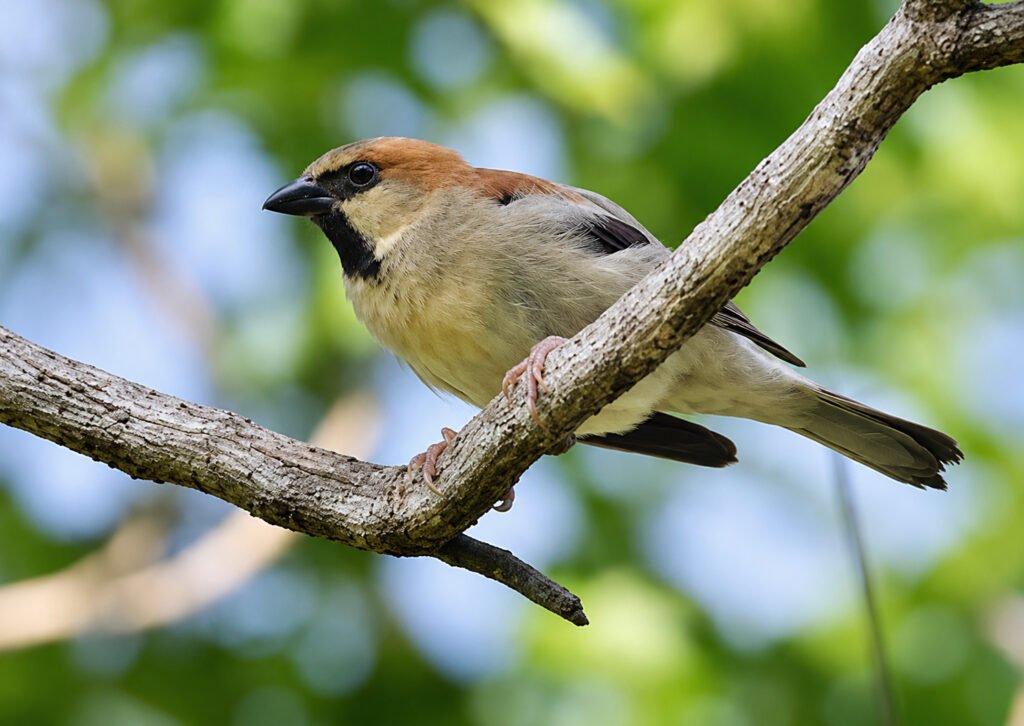
Our coastal targets in the bag, this day would involve a long drive Northeast to our last (and Thailand’s oldest) national park, Khao Yai. To break up the journey we had a few exciting stops planned, the first of which we came upon about an hour out of Pak Thale. Ton Maphrao is an easy path through high-quality farmland, and in an hour and half walking along it we racked up a healthy number of new species for so late in the trip. Birds like Plaintive Cuckoo, Black-headed Ibis, Yellow Bittern, Red-throated Pipit, Wood Sandpiper, cute and active little Yellow-bellied Prinia, and a huge flock of Asian Golden Weavers just starting to show hints of their vivid canary breeding plumage. We followed a Freckle-breasted Woodpecker along a row of spare palm trees, and watched more Blue-tailed Bee-eaters swish and dive over the fields in their all their rainbow-tone beauty. A Greater Spotted Eagle, huge and regal in our scopes, drifted low before settling in a gnarled tree. Close sightings gave us a chance to marvel at just how poorly named Plain-backed Sparrows are; clearly some of the prettiest members of their genus.
But we didn’t stop here for sparrows; Ton Maphrao’s claim to fame is that it’s home to a flock of critically endangered Yellow-breasted Buntings. Decimated throughout Asia by both trapping and changes in agricultural practices, they are suffering one of the most precipitous declines of any bird in recent history; a mere 40 years ago this species was classified as ‘Least Concern,’ and was abundant across a huge swathe of Eurasia. If it’s to avoid the fate of the passenger pigeon, a once similarly numerous species, suitable habitat in its wintering grounds across Thailand and the rest of Sout-east Asia urgently need greater protections. We found the many dozen chattering buntings, and stood for a while as they banked and darted around us. The flock would settle for a moment, then periodically take flight together in thundering woosh with white wing-patches flashing vivaciously in the sun. Eventually with traffic to beat, it was back into the vans, and we left Ton Maphrao’s Yellow-breasted Buntings to their precarious future.
Crossing Bangkok again, we stopped for lunch at a huge indoor food market. This was an experience in itself; picture a vast conference hall packed with food stalls selling every imaginable cuisine, and the intermingling smells of hundreds of different dishes being cooked on the spot. We each ventured off to explore its culinary treasures, and enjoyed having a meal amongst the many local families, workers, and students who congregated here to socialise and eat. Pushing on, we arrived at the foot of the mountain which hosts Sila Thong Cave on the outskirts of Khao Yai, just before dusk. Here we took our last pit stop to watch one of nature’s great spectacles, the emergence of several million wrinkle-lipped bats from the cave mouth. Twisting and weaving, spiral clouds of bats streamed like locusts from the mountainside as the light began to dim. Shikras prowled over the ridgeline with predatory hunger, positioning to snatch a morsel from the innumerable mass of flesh and wings.
Day 19, 9th February – Khao Yai
Khao Yai, Thailand’s oldest and busiest national park and a UNESCO World Heritage Site. Our last major stop of the tour, it gave us an excellent chance to target many of the most iconic Thai jungle species. From our accommodation just outside the park, we drove its winding but well tarmacked forest roads, and I was struck by a wash of nostalgia for the time I hitch-hiked into the park on my first visit to the country in 2024. Our two air-conditioned minibuses gave made the journey considerably simpler this time around, and we took immediate advantage of our independence by driving up the mountain road to the highest elevations of the park; cool and drizzly, cloaked in cloud cover. We walked the Pha Dieo Dai boardwalk, but the weather was suppressing bird activity, and it was eerily quiet apart from a solitary Yellow-billed Whistlingthrush. This was more than made up for by a breathtaking encounter with an Indochinese Serow, a large antelope-like relative of Musk Ox and goats, rare across its range and highly threatened by poaching.
After this we carried on to a viewpoint at the top of the park for some morning coffee, where we found a juvenile Mountain Imperial Pigeons getting fed by a parent. Heading back to an area of forest known for the majestic Silver Pheasant, we drove slowly down the hill, peering into the gloomy understory as we went. We were rewarded with a flash of dazzling “argent” as a long-tailed male perched out into full view. Halting the cars, we quietly followed him into the forest, and his small flock came into good view on several occasions as he led two females down through the damp and dimly lit trails of their forest home. At the lower elevations of the road, I spotted a Banded Kingfisher perched on an overhanding cable and we quickly pulled over, but it agonisingly flicked away before the front half of our convoy could reverse back to see it. Our spirits were considerably lifted by a pair of frankly ridiculous Long-tailed Broadbills; a bird whose pompadour hairdo and brilliantly gaudy colours suggest the King of Rock and Roll if he had come off the worse in a rather violent paintball fight.
With huge swathes of the park to explore, we began by staking out a fruiting tree teeming with activity. A pair of Hume’s White-eyes were soon joined by a Square-tailed Drongo Cuckoo, a pair of Brown-rumped Minivets, and a Black-naped Oriole. Another pair of Long-tailed Broadbills parched up nearby, and best were two vast Wreathed Hornbills which flew overhead with audible, powerful wingbeats. In the areas around the headquarters complex, we had good open country birds including Golden-headed Cisticola and Chestnut-headed Bee-eaters. I knew the trees around the carpark here were good for Cambodian Flowerpecker having seen them on my last visit, so I searched for this highly range restricted species while the group waited for lunch. I soon found a pair and called everyone over, and we got to observe the lovely coppery-blue back of the male as they flitted about in their preferred tree. This was also a good area for woodpeckers, with many Greater Flamebacks as well as a Heart-spotted Woodpecker in the tall trees around the river.
After a rather spicy lunch we walked the KM33 trail. Nang quickly found a Collared Owlet calling above the trail entrance, which showed off the false eyes on the back of its head as it scanned the surroundings. The trail was otherwise quiet, with just a pair of Pin-striped Tit-Babblers and a Hill Blue Flycatcher. Our final stop in the park was the trail loop behind the headquarters building. We found two Radde’s Warblers skulking around at the start of the path, then spotted an exquisite male Red-headed Trogon, perching out obligingly to give us by far our best look at this iconic species. It was soon joined by the female, and we were immensely satisfied with walk-away views of both sexes. Wikipedia gives a pretty ungenerous quote on the family’s typically calm vibe; “apart from their great beauty [trogons] are notorious for their lack of other immediately engaging qualities” – I’d like to introduce that author to the hyperactive individual we met in Kaeng Krachan, maybe they’d learn some appreciation! Further along we hit on a small flock of Alstrom’s Warblers and a couple of Pale-legged Leaf-Warblers. A Common Kingfisher was perching over the stream we crossed back to the visitor’s centre, and in its carpark, we were accosted by a group of juvenile Pig-tail Macaques.
Nang had one final treat for us, for after trundling back up the windy forest road to the park entrance, our guests learned we were not yet headed for home. Just past our accommodation there is a stake out for Spot-bellied Eagle Owl. Arriving to the cacophonous racket of a flock of Red-breasted Parakeets, we only had to wait a few minutes before this goliath of a nightbird emerged, jet-black eyes glinting in the evening’s fading glow. It flew right overhead to challenge a Great Hornbill for a perch; watching these two huge species face off was the most jaw-dropping moment of animal behaviour we witnessed on the trip.
Day 20, 10th February – Khao Yai
On our second day in Khao Yai, we set off early to get to a productive fruiting tree deep in the jungle at the peak of bird activity. Before the morning gloom had really begun to lift, guests in the first van got brief looks at a pair of Siamese Fireback as they crossed the road. Unfortunately pulling over to intensively scan the undergrowth into which they disappeared yielded no rewards. It’s an unfortunate reality of using two vans on single lane paths that on occasion one group might see a bird that disappears by the time the other gets there. This was more than outweighed, though, by the flexibility this setup provided, particularly in cases where some of the group preferred to return to relax at the accommodation, while others preferred to push on birding, they were especially valued. Despite serious effort put in on both days to find this it, this pheasant continued to elude us, and it went down as one of our more disappointing species, though I’m glad to say this was a very small list. Further up the track, we pulled over to watch a group of Moustached Barbets which came down practically to eye level, a treat never taken for given with this family. We set up scoped underneath the vast canopy of the fruiting tree and after some waiting our target bird, a pair of the rare and exquisite Golden-crested Myna, joined the throngs of Ashy Drongos, Sultan Tits and their Common Hill Myna cousins. Several Great Hornbills joined the feeding party throughout the morning, each time landing with a crash to shake the tree’s highest branches.
We punctuated another lunch at the headquarters area with a stroll along an adjacent river, and earned quick views of a Blue-bearded Bee-eater, and rather better ones of some of the park’s many delightful butterflies. We then visited Haew Suwat waterfall. With a reservoir swollen from months of heavy, nourishing downpours, the tannin-rich waters of Haew Suwat thundered ferociously as they cascaded down. Birding down the path beside the waterfall was productive with our first Rosy Minivets joining a flock of Brown Winged Minivets and Sultan Tits. Black-winged Cuckooshrikes gave us our closest views. Listening hard in an area known for Banded Kingfisher, we picked up on its call and, following it, soon located a male perching just above head-height. While photographing it, we found yet another Red-headed Trogon; these really aren’t rare birds in Khao Yai!
Nang then received a call from a friend, telling her an Eared Pitta had been seen at the KM.33 trail. Wasting no time, we leapt into the vans. As we approached the trailhead the excitement was palpable; though Khao Yai is among the only sites where this species is regularly seen, anyone visiting expecting to see it is more than likely to leave disappointed. With less than eight hundred eBird records despite a range spanning five countries in mainland South-east Asia, it has a claim to being one of the more elusive members of its family. We began walking the trail in total silence, and quickly found a Scaly-legged Partridge rustling at leaf-litter. We were stopped dead in our tracks as the Pitta’s mournful whistle pierced the silence. Crouching, we edged our way to the source of the call, and soon we spotted it – with a silver-brow stripe and gingerbread coloured body, it hopped around the ground entirely oblivious to the group of birders whose days it had just made several times over. A typical Northern-Central birding itinerary will only usually expect to find Blue Pitta, so to have added not one but two more of this sought-after family (including the Blue-naped in the north) was one of the trip’s great triumphs.
We rounded off our afternoon with an exceptionally marked female White-throated Rockthrush, with another Cambodian Flowerpecker nearby, before coming across two different groups of Asian elephants in the vicinity of one of the campsites. As we photographed them, another three Wreathed Hornbills flew overhead, completing a pretty iconic diorama of the Asian jungle. Over a large lake, squadrons of Brown-backed Needletails hawked like fighter pilots; large swifts are always thrilling and these huge, stately speed demons put on an acrobatic show. Our final night as a group was drawing in, so we set up camping chairs at the Old Golf Course and settled in to watch as Great-eared Nightjars drifted like toy kites over the jagged treeline. As Nang would be leaving us early the next day, we celebrated the trip with a dinner at a luxurious restaurant near our accommodation. Over a healthy quantity of excellent wine we reminisced about the trip, enjoyed each other’s company, and were treated to a touching speech by Roger. Though there was an air of bittersweet finality about the occasion, I’m pleased to report that Thailand’s birds weren’t done with us quite yet…
Day 21, 11th February – Wat Pra Phuttabaht Noi to Bangkok
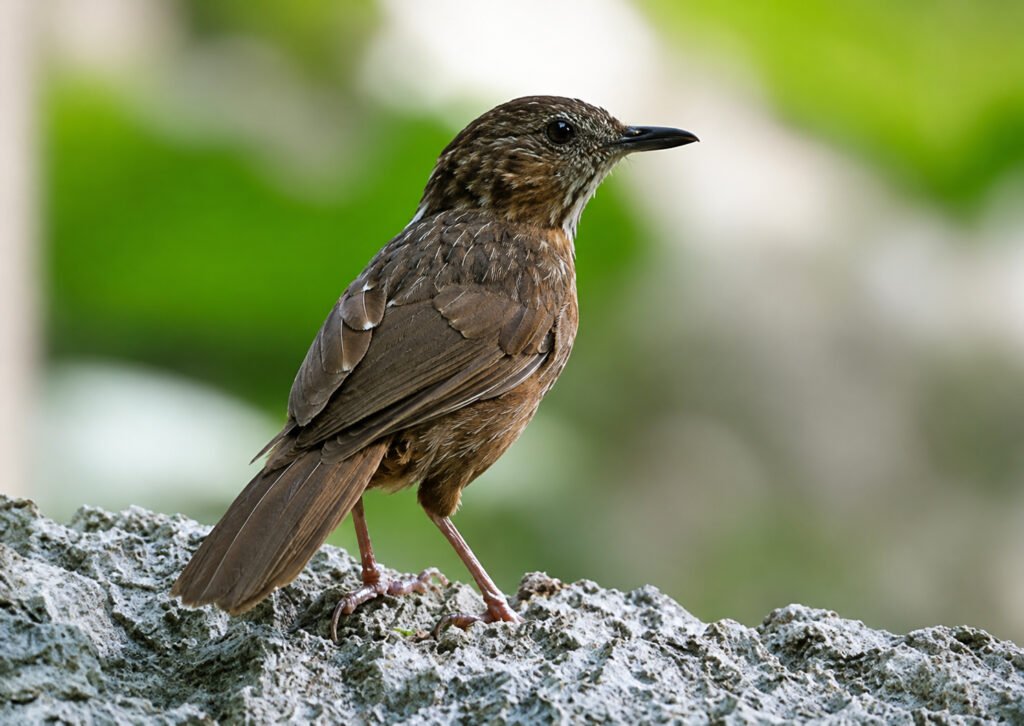
Though the trip was ending, no one felt especially eager for it to be over, and in that spirit, we took a rather languid route back to Bangkok. Though it wasn’t on the official itinerary, our route to the capital swung close to absolutely minute range of one of Thailand’s only two endemic birds; Rufous Limestone Babbler. We all agreed that it would be a great way to cap off a fantastic trip, and being so close the opportunity felt impossible to pass up. We timed our arrival so that the steps up to Wat Phra Phuttabat Noi ,a temple in the shadow of the great limestone karst formations this species exclusively inhabits, were shaded. This made our search cool and pleasant, and within a few minutes we found our target. It was both active and tame, often coming within just a few meters as it foraged. This felt like an earned reward for the many hot hours we’d invested on trails over the course of the trip, as if Thailand was seeing us off with a gift.
Near the outskirts of Bangkok we stopped for lunch at a Chinese restaurant surrounded by a vast lily pond, and dined on a fusion of Chinese and Thai favourites. A handsome Golden Weaver, very nearly in its full breeding regalia, kept us company as we each voted for our birds of the trip. Unsurprisingly Spoon-billed Sandpiper took the top spot, while Blue and Eared Pitta respectively took the remaining podium places. In fourth was Long-tailed Broadbill and fifth Banded Kingfisher, two crowd-pleasing gems we’d enjoyed close and unhurried views of in Khao Yai.
Before reaching our hotel, we had allocated time for one final stop. Though urban areas hold poorer diversity than the kind of wilderness we’d spent most of the trip exploring, those species that are well adapted to them can often be seen far more easily there due to their habituation to human presence. With this in mind, we spent a final hour at Bangkok’s Rot Fai Park to add a few final birds and hopefully part on an excellent and easy-going note. First was Stork-billed Kingfisher with its huge lipstick-red bill, which we quickly found perching on an island in the middle of a pond. Further on, a Spotted Owlet glared out of a known nest-hole with striking yellow eyes. Our final lifer for the trip was Collared Scops Owl, which peered at us sleepily through furrowed brows from its daytime roost high in an old fir tree. Three lovely species no less appreciated for the ease of finding them. We got to our hotel, the comfortable Cottage at Suvarnabhumi, and said goodbye to Nang and Pichit, our driver. One last dinner together for those of us who remained, then we bade goodnight and prepared for our next steps, be that home to the UK or South Africa, to enjoy Bangkok’s hospitality for a while longer, or for onward travel to Indonesia as in my case. With a final species tally of 419 (including a good many of South-east Asia’s most impressive and sought after species,) seen in the midst of beautiful natural scenery, punctuated by delicious food, and all enjoyed in fine company, this edition of Calidris Birding Tours North and Central Thailand tour came to a close.
Bird of the Trip
- Spoon-billed Sandpiper
- Blue Pitta
- Eared Pitta
- Long-tailed Broadbill
- Banded Kingfisher
Mae Taeng: An area of riverine habitat and nearby famrland that forms an agricultural irrigation project. Sand bars, areas of gravel, open water and dense riverside vegetation is bordered by patches of dry diterocarp woodland and farmland. This is a good location in the early morning to see a good selection of commoner open-country and wetland species as well as some woodland birds. This is a reliable location for a few rarer birds too.
Huai Bong Reservoir: A small artificial wetland surrounded by secondary dry dipterocarp woodland. A good location for a variety of species in the early morning.
Fang Rice Fields: A small area of rice fields, that often contain large areas of rice stubble in January/February, with low hills close by. This is a good spot for a few species that are localized in distribution including Oriental Skylark, Green Sandpiper, Citrine Wagtail and a small number of wintering Chestnut-eared Buntings. This is also a good location for Pied Harrier.
Doi Lang West: One of the premier birding locations in all of Thailand with extensive access to a variety of forest types on a mountain ridge at around 1800 metres above sea level. Several species are found only here within Thailand and many others are easier to see here than at most other sites. Some of the specialities are Himalayan Cutia, Spot-breasted Parrotbill, Mrs Hume’s Pheasant, Giant Nuthatch and Scarlet-faced Liocihla.
Doi Lang East: Another superb site adjacent to the previous one but with a much moister forest habitat covering much of the area. Harder to access but worth the effort for birds such as Chestnut-headed Tesia, Scarlet-faced Liocichla, Himalayan Bluetail, Crested Bunting and much more.
Semok Horse Farm: A series of open fields borders low, forested foothills where one of Thailand’s most range-restricted birds occurs: Blue-naped Pitta.
Thatorn Rice Fields: An extensive area of rice fields and vegetable crops divided by a series of small rivers and drainage ditches where a good variety of wetland and open-country birds can be found. Given its northerly location there have been a high number of rarities found here and birds such as Siberian Rubythroat, Pied Harrier and Yellow-breasted Bunting are regular.
Doi Inthanon National Park: This national park contains Thailand’s highest peak at 5565 metres with a succession of forest habitats at various altitudes of the mountain, ranging from dry dipterocarp forest in the foothils to moist, ferny forest at the summit. Containing a wide variety of bird species from Thailand’s northern mountains this is a key site generally and specifically the highest part of the mountain contains a number of species that are more or less restricted to the location within the country such as Green-tailed Sunbird, Chestnut-tailed Minla and Ashy-throated Warbler.
Doi Lo Paddies: This area of rice fields provides a nice selection of wetland and open-country birds in a part of the country where much of the focus is on forest birding. During migration and the early part of “winter” it has a habit of drawing in rarities including a good variety of raptors.
Khok Kham: An area of aquaculture that includes shrimp farms, fish ponds and areas of salt farms in which wintering shorebirds gather. This is the closest location to Bangkok, and most reliable, for seeing the critically endangered Spoon-billed Sandpiper.
Tha Laeng: An area of old quarry pits and salinized abandoned farmland that hosts a selection of birds that are not found in more moist areas. The main reason for visiting this area is to see Indian Thick-knee which is regular here.
Kaeng Krachan National Park: The largest national park in Thailand and part of a much greater area of forest which extends over the border with Myanmar, containing a great wealth of birdlife. A range of altitudes and forest types means that a very wide variety of forest species can be seen here including birds that are characteristic of both Southern and Northern Thailand. Here birders can connect with an exciting set of birds including broadbills, hornbills, woodpeckers and many others. This is the only site in Thailand for Ratchet-tailed Treepie.
Phetchaburi Rice Fields: A large area of rice fields and fish ponds that always contains a variety of growth stages of rice from ploughed fields through growing rice to stubble fields which attracts a wide variety of species at all times of the year. This is a regular site for a wintering flock of Yellow-breasted Buntings and rice stubble fields attract wintering raptors such as Pied Harrier and Greater Spotted Eagle. Apart from specialities such as these a high number of wetland and open-country species can be seen in a morning here.
Laem Pak Bia/Pak Thale: An extensive area of salt farms, shrimp farms and associated coastal habitats that attracts very large numbers of shorebirds, egrets and terns. Probably the best wader-watching site in Thailand in terms of the variety of species, rarity of key birds and sheer numbers. A reliable site for Spoon-billed Sandpiper, Nordmann’s Greenshank and Asian Dowitcher, although the former can often be difficult to locate these days. Undisturbed beaches also host Malaysian Plover and White-faced Plover can often be found alongside these birds in small numbers.
Khao Yai National Park: Thailand’s oldest national park and one of the most visited located on a plateau at around 600-1000 metres above sea level. A mixture of mature semi-deciduous forest is interspersed with grassland habitats plays host to some regional specialities including Siamese Fireback, Moustached Barbet, Cambodian Flowerpecker and Coral-billed Ground Cuckoo. A good selection of forest birds can usually be seen here.
Wat Pra Phuttabaht Noi: A Buddhist temple set with scenic limestone karst scenery with wooded lower slopes. In the early morning a good selection of species can be seen here but the speciality is one of Thailand’s few endemic species: Rufous Limestone Babbler.
Rot Fai Park: A large city park, on the site of a former golf course, which has become one of Bangkok’s best birding sites with areas of mature trees, tree-fringed waterways, lily ponds, ornamental gardens and lawns. A good location for finding roosting Spotted Owlet, Collared Scops Owl and passage migrants at the right time of the year.
The sites at which each species were seen are coded as below;
- Mae Taeng: MT
- Huai Bong Reservoir: HBR
- Fang Rice Fields: FRF
- Doi Lang West: DLW
- Doi Lang East: DLE
- Semok Horse Farm: SHF
- Thatorn Rice Fields: TRF
- Doi Inthanon: DI
- Doi Lo Paddies: DLP
- Khok Kham: KoK
- Tha Laeng: TK
- Kaeng Krachan: KK
- Phetchaburi Rice Fields: PRF
- Laem Pak Bia: LPB
- Pak Thale: PT
- Khao Yai: KY
- Wat PraPhuttabaht Noi: WPN
- Rot Fai Park: RFP
During this tour a total of 416 full species were seen.
SPECIES
ANSERIFORMES: Anatidae
Lesser Whistling Duck
GALLIFORMES: Phasianidae
Rufous-throated Partridge
Bar-backed Partridge
Scaly-breasted Partridge
Green Peafowl
Grey Peacock Pheasant
Mountain Bamboo Partridge
Red Junglefowl
Mrs Hume’s Pheasant
Kalij Pheasant
Silver Pheasant
Siamese Fireback
CAPRIMULGIFORMES: Caprimulgidae
Grey Nightjar
Large-tailed Nightjar
Indian Nightjar
APODIFORMES: Hemiprocnidae
Crested Treeswift
APODIFORMES: Apodidae
Himalayan Swiftlet
White-nest Swiftlet
Brown-backed Needletail
Asian Palm Swift
Cook’s Swift
House Swift
CUCULIFORMES: Cuculidae
Greater Coucal
Green-billed Malkoha
Asian Koel
Asian Emerald Cuckoo
Plaintive Cuckoo
Square-tailed Drongo Cuckoo
Large Hawk Cuckoo
COLUMBIFORMES: Columbidae
Feral Pigeon
Speckled Woodpigeon
Oriental Turtle Dove
Red Collared Dove
Spotted Dove
Asian Emerald Dove
Zebra Dove
Thick-billed Green Pigeon
Yellow-vented Green Pigeon
Wedge-tailed Green Pigeon
Mountain Imperial Pigeon
GRUIFORMES: Rallidae
Common Moorhen
Grey-headed Swamphen
White-browed Crake
Ruddy-breasted Crake
White-breasted Waterhen
CHARADRIIFORMES: Burhinidae
Indian Thick-knee
CHARADRIIFORMES: Recurvirostridae
Black-winged Stilt
Pied Avocet
CHARADRIIFORMES: Charadriidae
Grey Plover
Pacific Golden Plover
Little Ringed Plover
Grey-headed Lapwing
Red-wattled Lapwing
Tibetan Sand Plover
Greater Sand Plover
Malaysian Plover
Kentish Plover
White-faced Plover
CHARADRIIFORMES: Jacanidae
Pheasant-tailed Jacana
Bronze-winged Jacana
CHARADRIIFORMES: Scolopacidae
Eurasian Whimbrel
Far Eastern Curlew
Eurasian Curlew
Black-tailed Godwit
Asian Dowitcher
Pin-tailed Snipe
Terek Sandpiper
Common Sandpiper
Green Sandpiper
Marsh Sandpiper
Wood Sandpiper
Common Redshank
Nordmann’s Greenshank
Spotted Redshank
Common Greenshank
Great Knot
Red Knot
Ruff
Broad-billed Sandpiper
Curlew Sandpiper
Long-toed Stint
Red-necked Stint
Spoon-billed Sandpiper
Sanderling
CHARADRIIFORMES: Glareolidae
Small Pratincole
CHARADRIIFORMES: Laridae
Little Tern
Caspian Tern
Whiskered Tern
Common Tern
Great Crested Tern
Slender-billed Gull
Brown-headed Gull
CICONIIFORMES: Ciconiidae
Asian Openbill
Painted Stork
SULIFORMES: Anhingidae
Oriental Darter
SULIFORMES: Phalacrocoracidae
Little Cormorant
Indian Cormorant
PELECANIFORMES: Threskiornithidae
Black-headed Ibis
Glossy Ibis
PELECANIFORMES: Ardeaidae
Yellow Bittern
Black-crowned Night Heron
Pacific Reef Egret
Chinese Egret
Little Egret
Little Heron
Chinese Pond Heron
Javan Pond Heron
Great Egret
Medium Egret
Eastern Cattle Egret
Grey Heron
Purple Heron
ACCIPITRIFORMES: Accipitridae
Black-winged Kite
Crested Honey Buzzard
Himalayan Griffon
Crested Serpent Eagle
Mountain Hawk Eagle
Greater Spotted Eagle
Crested Goshawk
Shikra
Eastern Marsh Harrier
Pied Harrier
Black Kite
Brahminy Kite
Rufous-winged Buzzard
STRIGIFORMES: Strigidae
Collared Owlet
Spotted Owlet
Asian Barred Owlet
White-fronted Scops Owl
Oriental Scops Owl
Collared Scops Owl
Spot-bellied Eagle Owl
TROGONIFORMES: Trogonidae
Orange-breasted Trogon
Red-headed Trogon
BUCEROTIFORMES: Upupidae
Eurasian Hoopoe
BUCEROTIFORMES: Bucerotidae
Great Hornbill
Oriental Pied Hornbill
Tickell’s Brown Hornbill
Wreathed Hornbill
CORACIIFORMES: Coraciidae
Indochinese Roller
Dollarbird
CORACIIFORMES: Alcedinidae
Banded Kingfisher
Stork-billed Kingfisher
White-throated Kingfisher
Black-capped Kingfisher
Collared Kingfisher
Common Kingfisher
CORACIIFORMES: Meropidae
Blue-bearded Bee-eater
Asian Green Bee-eater
Blue-tailed Bee-eater
Chestnut-headed Bee-eater
PICIFORMES: Megalaimidae
Great Barbet
Lineated Barbet
Green-eared Barbet
Golden-throated Barbet
Blue-throated Barbet
Moustached Barbet
Blue-eared Barbet
Coppersmith Barbet
PICIFORMES: Picidae
Speckled Piculet
Heart-spotted Woodpecker
Grey-capped Pygmy Woodpecker
Freckle-breasted Woodpecker
Stripe-breasted Woodpecker
Greater Yellownape
Lesser Yellownape
Black-headed Woodpecker
Grey-headed Woodpecker
Common Flameback
Greater Flameback
Bay Woodpecker
Buff-rumped Woodpecker
FALCONIFORMES: Falconidae
Collared Falconet
Black-thighed Falconet
Peregrine Falcon
PSITTACIFORMES: Psittaculidae
Blossom-headed Parakeet
Red-breasted Parakeet
Vernal Hanging Parrot
PASSERIFORMES: Eurylaimidae
Long-tailed Broadbill
Black-and-red Broadbill
Banded Broadbill
PASSERIFORMES: Pittidae
Eared Pitta
Blue-naped Pitta
Blue Pitta
PASSERIFORMES: Acanthizidae
Golden-bellied Gerygone
PASSERIFORMES: Vangidae
Bar-winged Flycatcher-shrike
Large Woodshrike
PASSERIFORMES: Artamidae
Ashy Woodswallow
PASSERIFORMES: Aegithinidae
Common Iora
Great Iora
PASSERIFORMES: Campephagidae
Small Minivet
Grey-chinned Minivet
Short-billed Minivet
Long-tailed Minivet
Scarlet Minivet
Ashy Minivet
Brown-rumped Minivet
Rosy Minivet
Black-winged Cuckooshrike
PASSERIFORMES: Vireonidae
White-browed Shrike Babbler
Clicking Shrike Babbler
White-bellied Erpornis
PASSERIFORMES: Oriolidae
Maroon Oriole
Black-hooded Oriole
Black-naped Oriole
Slender-billed Oriole
PASSERIFORMES: Dicruridae
Bronzed Drongo
Lesser Racket-tailed Drongo
Greater Racket-tailed Drongo
Hair-crested Drongo
Ashy Drongo
Black Drongo
PASSERIFORMES: Rhipiduridae
White-throated Fantail
Malaysian Pied Fantail
PASSERIFORMES: Monarchidae
Black-naped Monarch
Blyth’s Paradise-Flycatcher
PASSERIFORMES: Laniidae
Burmese Shrike
Brown Shrike
Long-tailed Shrike
Grey-backed Shrike
PASSERIFORMES: Corvidae
Eurasian Jay
Red-billed Blue Magpie
Grey Treepie
Rufous Treepie
Racket-tailed Treepie
Ratchet-tailed Treepie
Large-billed Crow
PASSERIFORMES: Stenostridae
Yellow-bellied Fairy-Fantail
Grey-headed Canary-Flycatcher
PASSERIFORMES: Paridae
Yellow-browed Tit
Sultan Tit
Asian Tit
Yellow-cheeked Tit
PASSERIFORMES: Alaudidae
Oriental Skylark
PASSERIFORMES: Pycnonotidae
Ochraceous Bulbul
Puff-throated Bulbul
Striated Bulbul
Olive Bulbul
Grey-eyed Bulbul
Ashy Bulbul
Mountain Bulbul
White-headed Bulbul
Black Bulbul
Black-headed Bulbul
Black-crested Bulbul
Streak-eared Bulbul
Stripe-throated Bulbul
Flavescent Bulbul
Red-whiskered Bulbul
Yellow-vented Bulbul
Sooty-headed Bulbul
PASSERIFORMES: Hirundinidae
Grey-throated Martin
Barn Swallow
Wire-tailed Swallow
Eastern Red-rumped Swallow
PASSERIFORMES: Pnoepygidae
Pygmy Cupwing
PASSERIFORMES: Cettidae
Yellow-bellied Warbler
Mountain Tailorbird
Slaty-bellied Tesia
Chestnut-headed Tesia
PASSERIFORMES: Aegithalidae
Black-throated Tit
PASSERIFORMES: Phylloscopidae
Buff-barred Warbler
Ashy-throated Warbler
Hume’s Warbler
Yellow-browed Warbler
Pallas’s Warbler
Yellow-streaked Warbler
Radde’s Warbler
Dusky Warbler
Alstrom’s Warbler
Two-barred Warbler
Greenish Warbler
Chestnut-crowned Warbler
Sulphur-breasted Warbler
Blyth’s Leaf Warbler
Claudia’s Leaf Warbler
Davison’s Leaf Warbler
PASSERIFORMES: Acrocephalidae
Oriental Reed Warbler
Thick-billed Warbler
PASSERIFORMES: Cisticolidae
Hill Prinia
Rufescent Prinia
Grey-breasted Prinia
Yellow-bellied Prinia
Plain Prinia
Common Tailorbird
PASSERIFORMES: Paradoxornithidae
Spot-breasted Parrotbill
Grey-headed Parrotbill
PASSERIFORMES: Zosteropidae
Striated Yuhina
Whiskered Yuhina
Chestnut-flanked White-eye
Swinhoe’s White-eye
Indian White-eye
Hume’s White-eye
PASSERIFORMES: Timaliidae
Chestnut-capped Babbler
Pin-striped Tit Babbler
Rufous-fronted Babbler
White-browed Scimitar Babbler
Brown-crowned Scimitar Babbler
Large Scimitar Babbler
Red-eyed Scimitar Babbler
Grey-throated Babbler
PASSERIFORMES: Pellorneidae
Collared Babbler
Rufous-winged Fulvetta
Puff-throated Babbler
Buff-breasted Babbler
Rufous Limestone Babbler
PASSERIFORMES: Alcippeidae
Brown-cheeked Fulvetta
Yunnan Fulvetta
PASSERIFORMES: Leiothrichidae
Himalayan Cutia
Silver-eared Laughingthrush
Dark-backed Sibia
Blue-winged Minla
Chestnut-tailed Minla
Spectacled Barwing
Silver-eared Mesia
Rufous-backed Sibia
Scarlet-faced Liocichla
Lesser Necklaced Laughingthrush
White-crested Laughingthrush
White-browed Laughingthrush
Greater Necklaced Laughingthrush
PASSERIFORMES: Irenidae
Asian Fairy Bluebird
PASSERIFORMES: Sittidae
Giant Nuthatch
Velvet-fronted Nuthatch
Chestnut-vented Nuthatch
PASSERIFORMES: Certhidae
Hume’s Treecreeper
PASSERIFORMES: Sturnidae
Golden-crested Myna
Common Hill Myna
Great Myna
Common Myna
Black-collared Starling
Siamese Pied Starling
Chestnut-tailed Starling
PASSERIFORMES: Turdidae
Dark-sided Thrush
Grey-winged Blackbird
Black-breasted Thrush
Eyebrowed Thrush
Grey-sided Thrush
Chestnut Thrush
PASSERIFORMES: Muscicapidae
Oriental Magpie Robin
White-rumped Shama
Dark-sided Flycatcher
Asian Brown Flycatcher
Rufous-bellied Nilatava
Large Niltava
Verditer Flycatcher
White-gorgetted Flycatcher
Pale-blue Flycatcher
Chinese Blue Flycatcher
Hainan Blue Flycatcher
Indochinese Blue Flycatcher
Hill Blue Flycatcher
White-tailed Robin
Siberian Rubythroat
Black-backed Forktail
Slaty-backed Forktail
Blue Whistlingthrush
Himalayan Shortwing
Lesser Shortwing
Siberian Blue Robin
Slaty-blue Flycatcher
Snowy-browed Flycatcher
Slaty-backed Flycatcher
Rufous-gorgetted Flycatcher
Little Pied Flycatcher
Taiga Flycatcher
Himalayan Bluetail
Plumbeous Redstart
White-capped Redstart
Daurian Redstart
Chestnut-bellied Rockthrush
White-throated Rockthrush
Blue Rockthrush
Grey Bushchat
Pied Bushchat
Amur Stonechat
PASSERIFORMES: Chloropseidae
Blue-winged Leafbird
Golden-fronted Leafbird
Orange-bellied Leafbird
PASSERIFORMES: Dicaeidae
Thick-billed Flowerpecker
Yellow-vented Flowerpecker
Fire-breasted Flowerpecker
Cambodian Flowerpecker
Scarlet-backed Flowerpecker
PASSERIFORMES: Nectariniidae
Ruby-cheeked Sunbird
Purple Sunbird
Ornate Sunbird
Black-throated Sunbird
Mrs Gould’s Sunbird
Green-tailed Sunbird
Crimson Sunbird
Little Spiderhunter
Streaked Spiderhunter
PASSERIFORMES: Passeridae
Eurasian Tree Sparrow
Plain-backed Sparrow
House Sparrow
PASSERIFORMES: Ploceidae
Asian Golden Weaver
Streaked Weaver
Baya Weaver
PASSERIFORMES: Estrilididae
Scaly-breasted Munia
White-rumped Munia
Pin-tailed Parrotfinch
Red Avadavat
PASSERIFORMES: Motacillidae
Eastern Yellow Wagtail
Citrine Wagtail
Grey Wagtail
White Wagtail
Richard’s Pipit
Paddyfield Pipit
Olive-backed Pipit
Red-throated Pipit
PASSERIFORMES: Fringillidae
Scarlet Finch
PASSERIFORMES: Emberizidae
Chestnut-eared Bunting
Yellow-breasted Bunting
Chestnut Bunting
SCIENTIFIC NAME
ANSERIFORMES: Anatidae
Dendrocygna javanica
GALLIFORMES: Phasianidae
Arborophila rufogularis
Arborophila brunneopectus
Tropicoperdix chloropus
Pavo muticus
Polyplectron bicalcaratum
Bambusicola fytchii
Gallus gallus
Symaticus humiae
Lophura leucomelanos
Lophura nycthemera
Lophura diardi
CAPRIMULGIFORMES: Caprimulgidae
Caprimulgus jotaka
Caprimulgus macrurus
Caprimulgus asiaticus
APODIFORMES: Apodidae
Hemiprocne coronatus
APODIFORMES: Apodidae
Aerodramus brevirostris
Aerodramus fuciphagus
Hirundapus cochinchinensis
Cypsiurus balasiensis
Apus cooki
Apus nipalensis
CUCULIFORMES: Cuculidae
Centropus sinensis
Phaenicophaeus tristis
Eudynamys scolopaceus
Chrysococcyx maculatus
Cacomantis merulinus
Surniculus lugubris
Hierococcyx sparverioides
COLUMBIFORMES: Columbidae
Columba livia
Columba hodgsoni
Streptopelia orientalis
Streptopelia tranquebarica
Spilopelia chinensis
Chalcophaps indica
Geopelia striata
Treron curvirostra
Treron seimundi
Treron sphenurus
Ducula badia
GRUIFORMES: Rallidae
Gallinula chloropus
Porphyrio poliocephalus
Poliolimnas cinereus
Zapornia fusca
Amaurornis phoenicurus
CHARADRIIFORMES: Burhinidae
Burhinus indicus
CHARADRIIFORMES: Recurvirostridae
Himanotopus himantopus
Recurvirostra avosetta
CHARADRIIFORMES: Charadriidae
Pluvialis squatarola
Pluvialis fulva
Thinornis dubius
Vanellus cinereus
Vanellus indicus
Anarhynchus atrifrons
Anarhynchus leschenaultii
Anarhynchus peronii
Anarhynchus alexandrinus
Anarhynchus dealbatus
CHARADRIIFORMES: Jacanidae
Hydrophasianus chirurgus
Metopidius indicus
CHARADRIIFORMES: Scolopacidae
Numenius phaeopus
Numenius madagascariensis
Numenius arquata
Limosa limosa
Limnodramus semipalmatus
Gallinago stenura
Xenus cinereus
Actitis hypoleucos
Tringa ochropus
Tringa stagnatilis
Tringa glareola
Tringa totanus
Tringa guttifer
Tringa erythropus
Tringa nebularia
Calidris tenuirostris
Calidris canutus
Calidris pugnax
Calidris falcinellus
Calidris ferruginea
Calidris subminuta
Calidris ruficollis
Calidris pygmaea
Calidris alba
CHARADRIIFORMES: Glareolidae
Glareola lactea
CHARADRIIFORMES: Laridae
Sternula albifrons
Hydroprogne caspia
Chlidonias hybrida
Sterna hirundo
Thalasseus bergii
Chroicocephalus genei
Chroicocephalus brunnicephalus
CICONIIFORMES: Ciconiidae
Anastomus oscitans
Mycteria leucocephala
SULIFORMES: Anhingidae
Anhinga melanogaster
SULIFORMES: Phalacrocoracidae
Microcarbo niger
Phalacrocorax fuscicollis
PELECANIFORMES: Threskiornithidae
Threskiornis melanocephalus
Plegadis falcinellus
PELECANIFORMES: Ardeaidae
Botaurus sinensis
Nycticorax nycticorax
Egretta sacra
Egretta eulophotes
Egretta garzetta
Butorides atricapilla
Ardeola bacchus
Ardeola speciosa
Ardea alba
Ardea intermedia
Ardea coromanda
Ardea cinerea
Ardea purpurea
ACCIPITRIFORMES: Accipitridae
Elanus caeruleus
Pernis ptilorhynchus
Gyps himalayensis
Spilornis cheela
Nisaetus nipalensis
Clanga clanga
Lophospiza trivirgata
Tachyspiza badia
Circus spilonotus
Circus melanoleucos
Milvus migrans lineatus
Haliastur indus
Butastur liventer
STRIGIFORMES: Strigidae
Taenioptynx brodiei
Athene brama
Glaucidium cuculoides
Otus sagittatus
Otus sunia
Otus lettia
Ketupa nipalensis
TROGONIFORMES: Trogonidae
Harpactes oreskios
Harpactes erythrocephalus
BUCEROTIFORMES: Upupidae
Upupa epops
BUCEROTIFORMES: Bucerotidae
Buceros bicornis
Anthracoceros albirostris
Anorrhinus tickelli
Rhyticeros undulatus
CORACIIFORMES: Coraciidae
Coracias affinis
Eurystomus orientalis
CORACIIFORMES: Alcedinidae
Lacedo pulchella
Pelargopsis capensis
Halcyon smyrnensis
Halcyon capensis
Todiramphus chloris
Alcedo atthis
CORACIIFORMES: Meropidae
Nyctyornis athertoni
Merops orientalis
Merops philippensis
Merops leschenaulti
PICIFORMES: Megalaimidae
Psilopogon virens
Psilopogon lineatus
Psilopogon faiostrictus
Psilopogon franklinii
Psilopogon asiaticus
Psilopogon incognitus
Psilopogon cyanotis
Psilopogon haemacephalus
PICIFORMES: Picidae
Picumnus innominatus
Hemicircus canente
Yungipicus canicapillus
Dendrocopos analis
Dendrocopos atratus
Chrysophlegma flavinucha
Picus chlorolophus
Picus erythropgius
Picus canus
Dinopium javanense
Chrysocolaptes guttacristatus
Blythipicus pyrrhotis
Meiglyptes grammithorax
FALCONIFORMES: Falconidae
Microhierax caerulescens
Microhierax fringillarius
Falco peregrinus
PSITTACIFORMES: Psittaculidae
Psittacula roseata
Psittacula alexandri
Loriculus vernalis
PASSERIFORMES: Eurylaimidae
Psarisomus dalhousiae
Cymbirhynchus macrorhynchos
Eurylaimus javanicus
PASSERIFORMES: Pittidae
Hydrornis phayrei
Hydrornis nipalensis
Hydrornis cyaneus
PASSERIFORMES: Acanthizidae
Gerygone sulphurea
PASSERIFORMES: Vangidae
Hemipus picatus
Tephrodornis virgatus
PASSERIFORMES: Artamidae
Artamus fuscus
PASSERIFORMES: Aegithinidae
Aegithina tiphia
Aegithina lafresnayei
PASSERIFORMES: Campephagidae
Pericrocotus cinnamomeus
Pericrocotus solaris
Pericrocotus brevirostris
Pericrocotus ethologus
Pericrocotus speciosus
Pericrocotus divaricatus
Pericrocotus cantonensis
Pericrocotus javensis
Lalage melaschistos
PASSERIFORMES: Vireonidae
Pteruthius aeralatus
Pteruthius intermedius
Erpornis zantholeuca
PASSERIFORMES: Oriolidae
Oriolus traillii
Oriolus xanthornus
Oriolus chinensis
Oriolus tenuirostris
PASSERIFORMES: Dicruridae
Dicrurus aeneus
Dicrurus remifer
Dicrurus paradiseus
Dicrurus hottentottus
Dicrurus leucophaeus
Dicrurus macrocercus
PASSERIFORMES: Rhipiduridae
Rhipidura albicollis
Rhipidura javanica
PASSERIFORMES: Monarchidae
Hypothymis azurea
Terpsiphone affinis
PASSERIFORMES: Laniidae
Lanius collurioides
Lanius cristatus
Lanius schach
Lanius tephronotus
PASSERIFORMES: Corvidae
Garrulus glandarius
Urocissa erythroryncha
Dendrocitta formosae
Dendrocitta vagabunda
Crypsirina temia
Temnurus temnurus
Corvus macrorhynchos
PASSERIFORMES: Stenostridae
Chelidorhynx hypoxanthus
Culcicapa ceylonensis
PASSERIFORMES: Paridae
Sylviparus modestus
Melanochlora sultanea
Parus cinereus
Machlolophus spilonotus
PASSERIFORMES: Alaudidae
Alauda gulgula
PASSERIFORMES: Pycnonotidae
Alophoixus ochraceous
Alophoixus pallidus
Alcurus striatus
Iole viridescens
Iole propinqua
Hemixos flavala
Ixos mcclellandii
Hypsipetes thompsoni
Hypsipetes leucocephalus
Brachypodius melanocephalus
Rubigula flaviventris
Pycnonotus conradi
Pycnonotus finlaysoni
Pycnonotus flavescens
Pycnonotus jocosus
Pycnonotus goiavier
Pycnonotus aurigaster
PASSERIFORMES: Hirundinidae
Riparia chinensis
Hirundo rustica
Hirundo smithii
Cecropis daurica
PASSERIFORMES: Pnoepygidae
Pnoepyga pusilla
PASSERIFORMES: Cettidae
Abroscopus superciliaris
Phyllergates cucullatus
Tesia olivea
Cettia castaneocoronata
PASSERIFORMES: Aegithalidae
Aegithalos concinnus
PASSERIFORMES: Phylloscopidae
Phylloscopus pulcher
Phylloscopus maculipennis
Phylloscopus humei
Phylloscopus inornatus
Phylloscopus proregulus
Phylloscopus armandii
Phylloscopus schwarzi
Phylloscopus fuscatus
Phylloscopus soror
Phylloscopus plumbeitarsus
Phylloscopus trochiloides
Phylloscopus castaniceps
Phylloscopus ricketti
Phylloscopus reguloides
Phylloscopus caludiae
Phylloscopus davisoni
PASSERIFORMES: Acrocephalidae
Acrocephalus orientalis
Arundinax aedon
PASSERIFORMES: Cisticolidae
Prinia superciliaris
Prinia rufescens
Prinia hodgsonii
Prinia flaviventris
Prinia inornata
Orthotomus sutorius
PASSERIFORMES: Paradoxornithidae
Paradoxornis guttaticollis
Paradoxornis gularis
PASSERIFORMES: Zosteropidae
Staphida castaniceps
Yuhina flavicollis
Zosterops erythropleurus
Zosterops simplex
Zosterops palpebrosus
Zosterops auriventer
PASSERIFORMES: Timaliidae
Timalia pileata
Mixornis gularis
Cyanoderma rufifrons
Pomatorhinus schisticeps
Pomatorhinus phayrei
Erythrogenys hypoleucos
Erythrogenys imberbis
Stachyris nigriceps
PASSERIFORMES: Pellorneidae
Gampsorhynchus torquatus
Schoeniparus castaniceps
Pellorneum ruficeps
Pellorneum tickelli
Gypsophila calcicola
PASSERIFORMES: Alcippeidae
Alcippe poioicephala
Alcippe fratercula
PASSERIFORMES: Leiothrichidae
Cutia nipalensis
Trochalopteron melanostigma
Heterophasia melanoleuca
Actinodura cyanouroptera
Actinodura strigula
Actinodura ramsayi
Leiothrix argentauris
Leioptila annectens
Liocichla ripponi
Garrulax monileger
Garrulax leucolophus
Pterorhinus sannio
Pterorhinus pectoralis
PASSERIFORMES: Irenidae
Irena puella
PASSERIFORMES: Sittidae
Sitta magna
Sitta frontalis
Sitta nagaensis
PASSERIFORMES: Certhidae
Certhia manipurensis
PASSERIFORMES: Sturnidae
Ampeliceps coronatus
Gracula religiosa
Acridotheres grandis
Acridotheres tristis
Gracupica nigricollis
Gracupica floweri
Sturnia malabarica
PASSERIFORMES: Turdidae
Zoothera marginata
Turdus boulboul
Turdus dissimilis
Turdus obscurus
Turdus feae
Turdus rubrocanus
PASSERIFORMES: Muscicapidae
Copsychus saularis
Copsychus malabaricus
Muscicapa sibirica
Muscicapa dauurica
Niltava sundara
Niltava grandis
Eumyias thalassinus
Anthipes monileger
Cyornis unicolor
Cyornis glaucicomans
Cyornis hainanus
Cyornis sumatrensis
Cyornis whitei
Myiomela leucura
Calliope calliope
Enicurus immaculatus
Enicurus schistaceus
Myophonus caeruleus
Brachypteryx cruralis
Brachypteryx leucophris
Larvivora cyane
Ficedula tricolor
Ficedula hyperythra
Ficedula erithacus
Ficedula stophiata
Ficedula westermanni
Ficedula albicilla
Tarsiger rufilatus
Phoenicurus fulginosus
Phoenicurus leucocephalus
Phoenicurus auroreus
Monticola rufiventris
Monticola gularis
Monticola solitarius
Saxicola ferreus
Saxicola caprata
Saxicola stejnegeri
PASSERIFORMES: Chloropseidae
Chloropsis moluccensis
Chloropsis aurifrons
Chloropsis hardwickii
PASSERIFORMES: Dicaeidae
Dicaeum agile
Dicaeum chrysorrheum
Dicaeum ignipectus
Dicaeum cambodianum
Dicaeum cruentatum
PASSERIFORMES: Nectariniidae
Chalcoparia singalensis
Cinnyris ornatus
Cinnyris ornatus
Aethopyga saturata
Aethopyga gouldiae
Aethopyga nipalensis
Aethopyga siparaja
Arachnothera longirostra
Arachnothera magna
PASSERIFORMES: Passeridae
Passer montanus
Passer flaveolus
Passer domesticus
PASSERIFORMES: Ploceidae
Ploceus hypoxanthus
Ploceus manyar
Ploceus philippinus
PASSERIFORMES: Estrilididae
Lonchura punctulata
Lonchura striata
Erythrura prasina
Amandava amandava
PASSERIFORMES: Motacillidae
Motacilla tschutschensis
Motacilla citreola
Motacilla cinerea
Motacilla alba
Anthus richardi
Anthus rufulus
Anthus hodgsoni
Anthus cervinus
PASSERIFORMES: Fringillidae
Carpodacus sipahi
PASSERIFORMES: Emberizidae
Emberiza fucata
Emberiza aureola
Emberiza rutila
SITES SEEN
ANSERIFORMES: Anatidae
HBR, LPB
GALLIFORMES: Phasianidae
DI
KK
KK, KY
DI
KK
DLW
DI, KK, KY
DLW
KK
KY
KY
CAPRIMULGIFORMES: Caprimulgidae
KK
KK
KK
APODIFORMES: Apodidae
HBR
APODIFORMES: Apodidae
KK
KoK, PRF, LPB
KY
Many locations
DLW, DLE, DAK
MT
CUCULIFORMES: Cuculidae
MT, SHF, TRF, KK, PRF
HBR, KK, KY
Many locations
DI, KK
PRF, RFP
KY
KK
COLUMBIFORMES: Columbidae
Ubiquitous
DI
DLW, DLE
Many locations
Ubiquitous
KK
Many locations
KK, KY
KK
DI, KK
DLW, KK, KY
GRUIFORMES: Rallidae
HBR
PRF
PRF
PRF
MT, TRF, PRF, SRF
CHARADRIIFORMES: Burhinidae
TL
CHARADRIIFORMES: Recurvirostridae
All wetland sites
LPB
CHARADRIIFORMES: Charadriidae
KoK, PT, LPB
PT, LPB
MT, TRF
PRF
MT, TL, KoK, PRF, KY
KoK, LPB
KoK, LPB
LPB
TRF, PT
LPB
CHARADRIIFORMES: Jacanidae
PRF
PRF
CHARADRIIFORMES: Scolopacidae
PT
LPB
PT
KK, LPB
LPB
TRF
LPB
MT, TRF, LPB
MT, TRF
KoK, PT, LPB
TRF, PRF, LPB
KoK, PT, LPB
LPB
LPB
KoK, PT, LPB
PT, LPB
PT
LPB
KoK, PT, LPB
KoK, LPB
LPB
KoK, LPB
KoK
LPB
CHARADRIIFORMES: Glareolidae
TRF
CHARADRIIFORMES: Laridae
KoK, LPB
KoK, LPB
KoK, PRF, LPB
PT, LPB
PT, LPB
LPB
KoK, PT, LPB
CICONIIFORMES: Ciconiidae
TRF, PRF
KoK, PT, LPB
SULIFORMES: Anhingidae
Kok, LPB
SULIFORMES: Phalacrocoracidae
KoK, KK, LPB, PRF, KY
PRF, LPB, KY
PELECANIFORMES: Threskiornithidae
PRF
PRF
PELECANIFORMES: Ardeaidae
PRF
LPB, RFP
LPB
LPB
Multiple locations
KY, RFP
Multiple locations
PRF, LPB
TRF, KoK, PRF, PT, LPB
TRF, KK, PRF, PT, LPB
MT, TRF, PRF
MT, HBR, KoK, PT, LPB, PRF
LPB, PRF
ACCIPITRIFORMES: Accipitridae
DLP
DAK
DLW
KK
DLW
PRF
HBR, KK
MT, KK
TRF, PT, PRF
FRF
DLP, PRF
KoK, PT, LPB, PRF
MT
STRIGIFORMES: Strigidae
KY
RFP
HBR
KK
KK
RFP
KY
TROGONIFORMES: Trogonidae
KK
KK, KY
BUCEROTIFORMES: Upupidae
TL
BUCEROTIFORMES: Bucerotidae
KK, KY
KK, KY
KK
KY
CORACIIFORMES: Coraciidae
TL, KK, KY
KK, KY
CORACIIFORMES: Alcedinidae
KY
RFP
MT, HBR, DLE, KK, PRF, KY
PRF
KoK, LPB
MT, SHF, PRF, KY
CORACIIFORMES: Meropidae
KK, KY
MT, DI, DLP
PRF
KK, KY
PICIFORMES: Megalaimidae
KK
MT, DI
KK
DLW, DAK, BL, DI
DLW, BL, KK
KY
KK, KY
MT, DI, RFP
PICIFORMES: Picidae
DI, KK
KK, KY
DI
PRF
DLW, DI
KK
DLW
DI
KK
DI, KK
KK, KY
DLE, DAK
KK
FALCONIFORMES: Falconidae
DI
KK
PT
PSITTACIFORMES: Psittaculidae
DI
KY
KK, KY
PASSERIFORMES: Eurylaimidae
KY
KK
KK
PASSERIFORMES: Pittidae
KY
SHF
KK
PASSERIFORMES: Acanthizidae
LPB
PASSERIFORMES: Vangidae
DAK, KK, KY
KK
PASSERIFORMES: Artamidae
TRF, KK, PRF, KY
PASSERIFORMES: Aegithinidae
DLW, SHF
KK
PASSERIFORMES: Campephagidae
MT, DI
DLW, DLE, DAK, DI
DAK
SHF, DI
HBR, DLW
KK
KY
KY
DAK, KK, KY
PASSERIFORMES: Vireonidae
DLW, DAK, DI, KK
DI
KK, KY
PASSERIFORMES: Oriolidae
DLW, DAK, DI
DI
KK, KY
DLW
PASSERIFORMES: Dicruridae
DLW, DLE, DAK
KK
DI, KK
TL, KK
DAK, SHF, DLW, KK, KY, WPN
MT, HBR, TRF, DI, PRF, LPB
PASSERIFORMES: Rhipiduridae
DLE, DLW
KoK, KK, LPB, PRF, RFP
PASSERIFORMES: Monarchidae
DAK, KK
KK
PASSERIFORMES: Laniidae
DAK
MT, PRF, KY
DAK, TRF
DLW, DI
PASSERIFORMES: Corvidae
DI
MT, HBR, DI
DLW
MT, HBR
KK
KK
MT, DI, LPB, PRF, KY, RFP
PASSERIFORMES: Stenostridae
DLE, DI
DLW, DAK, KK
PASSERIFORMES: Paridae
DI
KK, KY
DLW, DLE, DI
DI
PASSERIFORMES: Alaudidae
FRF, PRF
PASSERIFORMES: Pycnonotidae
KK
DI, KY
DLW, DI
KK
DI, KY
DLW, DLE, KK
DAK, KK
DAK
DI
DI, KK
All forest locations
Common in open country
KK
DLW, DLE, DAK, DI, KK
MT, DAK, TRF
PRF
HBR, DLW, DAK, DI
PASSERIFORMES: Hirundinidae
SHF
Most locations
MT
DAK, DI, KK, PRF, KY
PASSERIFORMES: Pnoepygidae
DLE, DI
PASSERIFORMES: Cettidae
KK
DLE
DLE, DI
DLE
PASSERIFORMES: Aegithalidae
DLW
PASSERIFORMES: Phylloscopidae
DLE, DI
DI
DLW, DAK, DI
MT, DLW, DI, KK, KY, WPN, RFP
DLW
DAK
KK, KY
MT
KK, Ky
SHF
DAK
DLW
KK
DI
DLW, DAK
DLW, DLE, DAK, DI
PASSERIFORMES: Acrocephalidae
LPB, PRF
KK
PASSERIFORMES: Cisticolidae
DI
MT
DLP
PRF
PRF
MT, KK, PRF
PASSERIFORMES: Paradoxornithidae
DLW
DLW
PASSERIFORMES: Zosteropidae
KK
DLE
DAK, DI
DAK, DI
DAK
KK, KY
PASSERIFORMES: Timaliidae
SHF
KK, KY
KK
DLW, KK
DLE
KK
DLW, DAK
DLW, DI
PASSERIFORMES: Pellorneidae
KK
DI
KK
DI
WPN
PASSERIFORMES: Alcippeidae
DI, KK
DLW, DAK, DI
PASSERIFORMES: Leiothrichidae
DLW
DLE, DI
DLE, DLW, DI
DLW, DAK, DI
DI
DLW, DLE
DAK, DI
DLW, DLE, DAK
DLW, DLE
HBR, KK
KK
DLW
KK
PASSERIFORMES: Irenidae
KK, KY
PASSERIFORMES: Sittidae
DAK, DLW
DLW, DAK, DI
DLW, DLE, DAK, DI
PASSERIFORMES: Certhidae
DLW
PASSERIFORMES: Sturnidae
KY
KK, KY
Common in open country
Common in urban areas
MT, DLE, TRF, RFP
All open country sites
DI
PASSERIFORMES: Turdidae
SHF
DAK
DAK, SHF
DAK, DI, KK
DAK, DI
DLE
PASSERIFORMES: Muscicapidae
MT, DLE, DAK, KoK, PRF, RFP
SHF, KK
KK
KK
DLW, DI
DLW, DLE, DAK, DI
KK, KY
DLE, DI
DLW, KK
KK
KK
KK
DLW, DAK, DI, KY
DLE, DI
DLW
DI
DI
DLE, DLW, DI, KY
DI
DLE, DI
SHF, DI, KK
DLW
DI
DLE, DI
DLW, DLE
DI
MT, HBR, TRF, KK, WPN
DLE, DI
DI
DI
DLW
DI
KY
DI
DLW, DLE, DAK
DAK, TRF
MT, DLE, TRF, PRF, KY
PASSERIFORMES: Chloropseidae
KK, KY
DI
DAK, DLW, DI
PASSERIFORMES: Dicaeidae
KK
DI, KK, KY
DLW, DI
KY
SHF, DI, KK, RFP
PASSERIFORMES: Nectariniidae
KK
MT, DI
MT, KoK, KK, KY, SRF
DAK, DI,KK
DLW, DLE, DAK, DI
DI
KK
KK
DI
PASSERIFORMES: Passeridae
All urban/village areas
PRF
TRF, KoK
PASSERIFORMES: Ploceidae
PRF
PRF
MT, TRF, PRF
PASSERIFORMES: Estrilididae
MT, HBR, TRF, PRFRFP
KK
KK
TRF
PASSERIFORMES: Motacillidae
PT, LPB, PRF
FRF, TRF
MT, DI
MT, TRF
LPB
TRF, DLP, KY
DLW, DAK
PRF
PASSERIFORMES: Fringillidae
DLW
PASSERIFORMES: Emberizidae
FRF
PRF
DLE
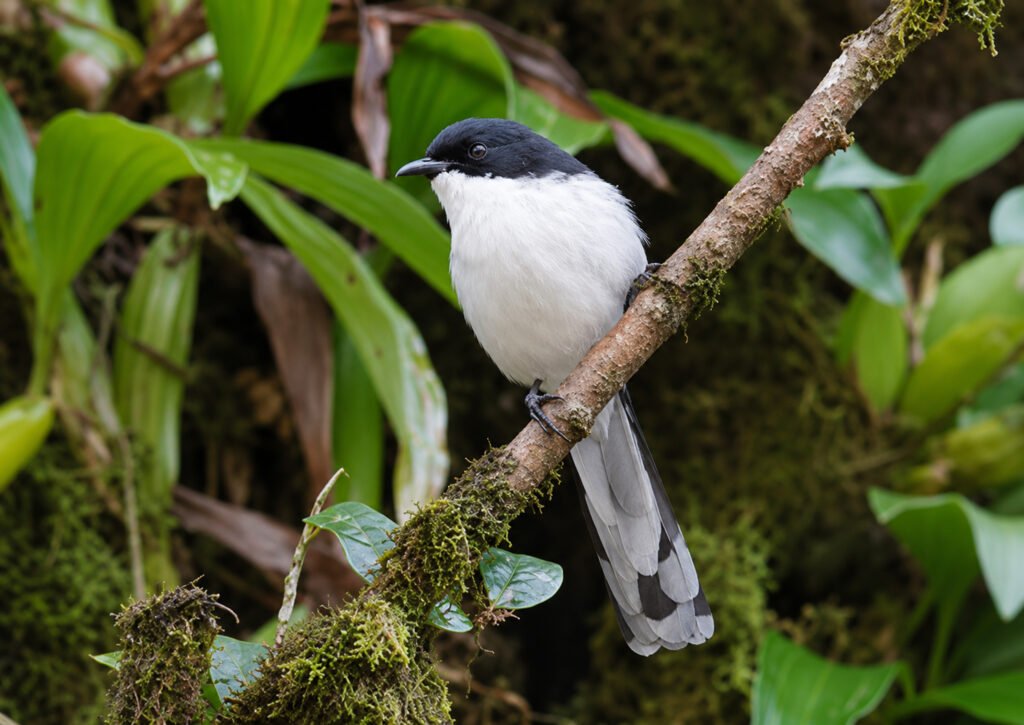
Dark-backed Sibia 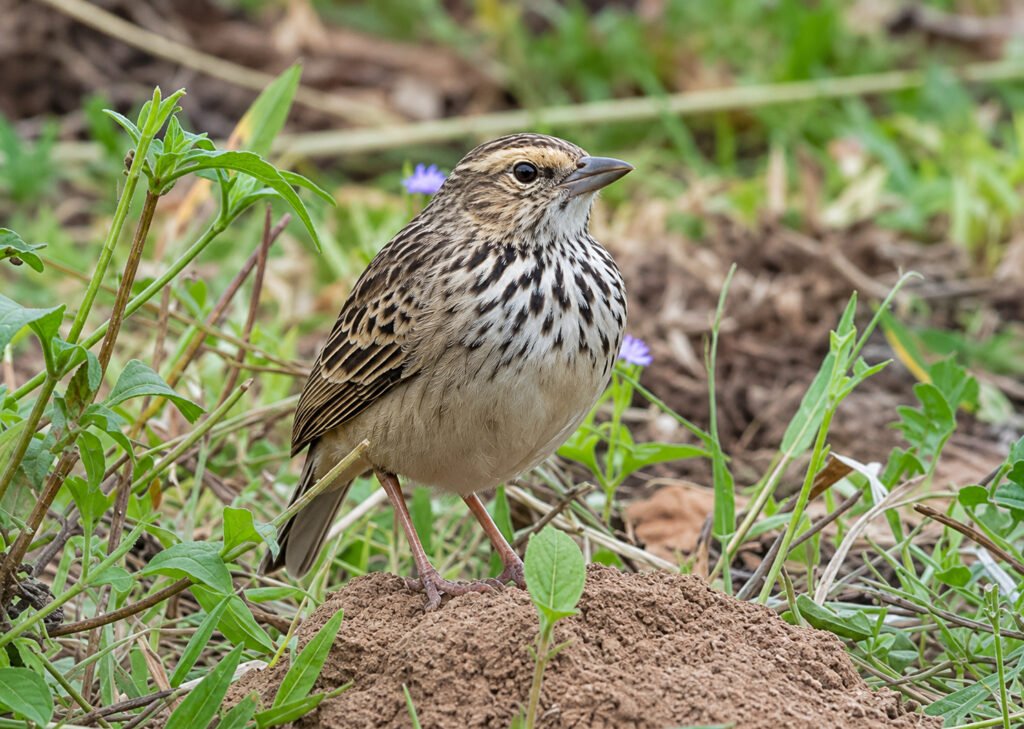
Indochinese Bushlark 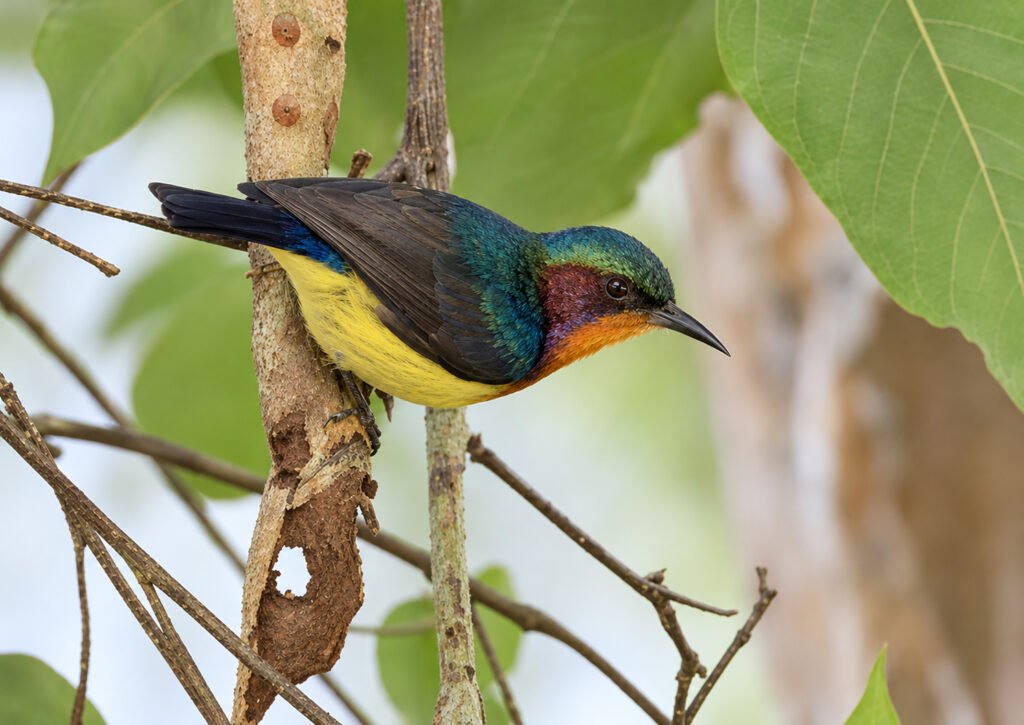
Ruby-throated Sunbird 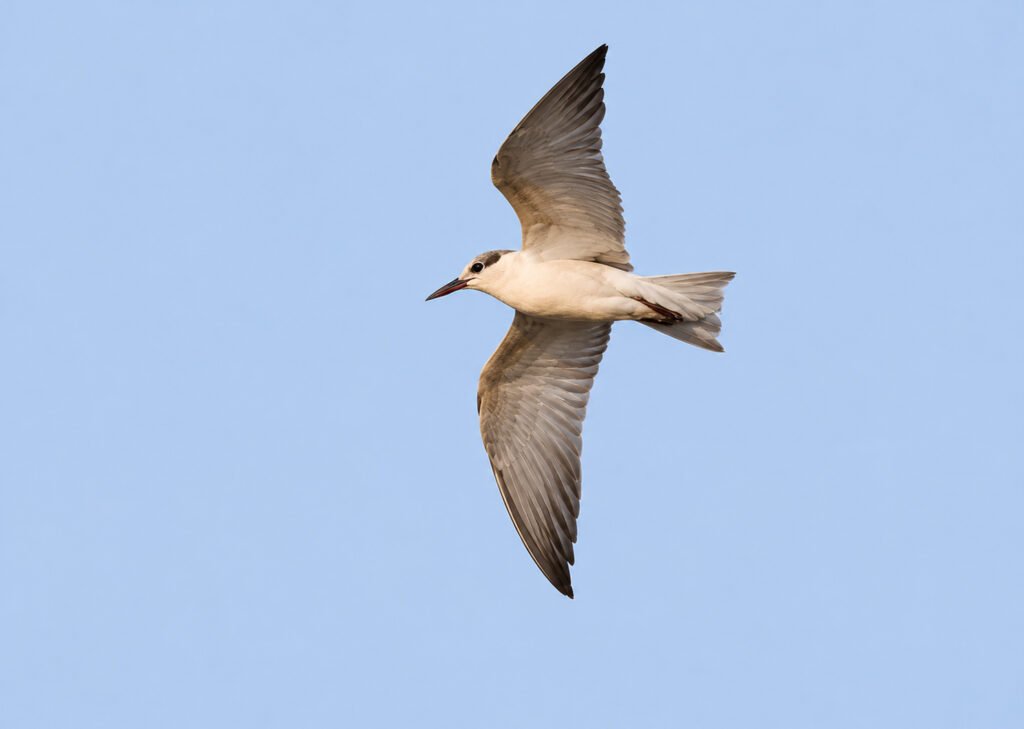
Whiskered Tern